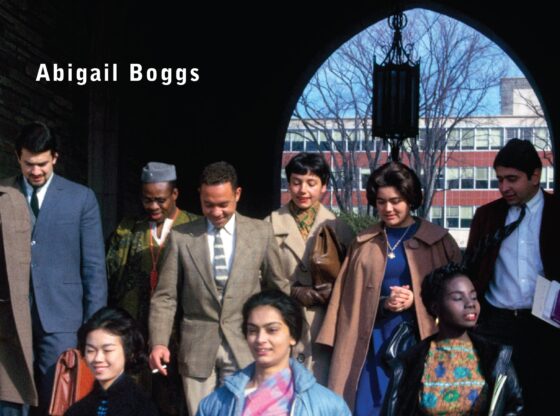
Abigail Boggs
My PhD is in cultural studies, a field whose methodological promiscuity has always seemed to me less a problem to overcome than a way of following questions wherever they lead. The work I learned to do moves among history and critical theory, political economy and literary analysis, legal studies and the study of race, empire, and culture. It begins less from the assumption that an object belongs to a particular discipline than from the conviction that the methods necessary to understand it should be determined by the problem itself. I would find myself continually wrestling with this as I transformed my dissertation into a book.
The origin story of how Degrees of Empire: Noncitizen Students and the Making of US Higher Education came to be a book speaks to the ways that methodology and political crises can alter what we see as particularly salient and foundational. The project originated more than two decades ago as a set of questions about the post-9/11 university and a contradiction surrounding the noncitizen student that the War on Terror had made difficult to miss. US universities were cultivating identities as global institutions and recruiting growing numbers of students from abroad, many of them nonwhite students from Asia, Africa, the Middle East, and Latin America. These students could be celebrated through a familiar model-minority logic: academically accomplished, economically productive, professionally ambitious, evidence both of the excellence of US universities and of the continuing desirability of the United States. At the same time, noncitizen students, especially those racialized as Arab, Muslim, Middle Eastern, or South Asian, became objects of intensified national security surveillance. Immigration status, nationality, race, religion, and political association could transform the exemplary student into the potential terrorist. The university welcomed the noncitizen student as a desirable subject of global mobility while the security state monitored precisely that mobility. As I began my studies, it became apparent that, while September 11 made this relationship harder to miss, it did not create it.
My dissertation therefore focused primarily on the period from the 1940s to what was then the present, mid-2013. But even that chronology quickly became unstable. In the 1950s and 1960s, enormous investments by US universities, foundations, and government agencies in recruiting students from decolonizing states existed alongside anxiety about what those students might become politically, as scholars such as Anton Tarradellas have shown. Educational exchange was supposed to cultivate relationships with future leaders during struggles over decolonization and the Cold War. The United States was also a place where African students encountered Black radicalism, anticolonialism, socialism, and the contradiction between American claims to global leadership and racial apartheid at home. By the 1970s, Arab, Iranian, Muslim, and Palestinian students were increasingly rendered politically suspect through emerging discourses of terrorism, particularly when their activism challenged US foreign policy, Zionism, or US support for Israel. Manijeh Moradian’s excellent history of Iranian student revolutionaries in the United States traces one particularly important part of this story. Long before September 11, the “terrorist” was becoming one figure through which particular noncitizen students could be distinguished from the desirable foreign student.
After the 2008 financial crisis, another dimension of the problem became harder to ignore. As universities confronted declining public support and mounting pressure on their financial models, the economic value of students from abroad became increasingly apparent. Noncitizen students brought tuition revenue. They also taught classes, conducted research, staffed laboratories, and participated in the production of the knowledge and prestige upon which universities depended. The value universities derived from noncitizen students was inseparable from the conditions under which those students were made available to them. Temporary status, restricted access to alternative employment, dependence on institutional certification, and vulnerability to interruption of status could limit the terms on which students studied and worked even as universities relied on their tuition and labor. Universities did not need to have designed these immigration restrictions in order to benefit from them. They could build financial and labor arrangements around populations whose mobility was enabled by the institution and constrained through the same relation. The contradiction was therefore material as well as representational. The noncitizen student could be model minority and potential terrorist, a source of revenue and object of surveillance, knowledge worker and temporary migrant, an instrument of American global power and critic of the political order into which they had been invited.
That was the project I expected to turn into a book. But as I revised the dissertation, the history kept pulling me further back.Questions I had understood as problems of the twentieth- and twenty-first-century university repeatedly opened onto earlier histories. Cold War educational exchange raised questions about the longer relationship between education and empire. The racialization of Arab, Iranian, Muslim, and Palestinian students led toward longer histories of immigration enforcement and political surveillance. The distinction between the desirable student and the threatening migrant led backward through the student visa, the immigration restrictions of the 1920s, and Chinese exclusion.
Eventually, even those histories proved insufficient. Educational mobility and US power abroad led toward missionary education and imperial expansion. Those histories made it difficult to begin an account of US higher education without confronting Indigenous education, settler colonialism, and the production of the territorial order that would eventually make a distinction between “domestic” and “international” students imaginable. The deeper genealogy that became Degrees of Empire was not the project I initially set out to write. However, making sense of the present seemed to demand it. So did changes in the intellectual landscape around the project. The Abusable Past’s own microsyllabus on critical university studies, compiled by Eli Meyerhoff and Zach Schwartz-Weinstein, captures one version of the intellectual formation out of which what we came to call abolitionist university studies emerged.
This work made increasingly untenable a familiar history in which universities simply became more diverse, accessible, and global over time. It also made it difficult to treat settler colonialism, immigration, racial formation, labor, and empire as contexts surrounding higher education rather than processes through which US universities themselves were made. The chronology of the project expanded because its object had changed. Or, perhaps more accurately, I had stopped assuming that the object I began with was self-evident.
The Genealogy of a Category
In “Nietzsche, Genealogy, History,” Michel Foucault’s account of genealogy helps me describe the method that emerged through the research. I did not begin with a Foucauldian method and go looking for an archive that would demonstrate it. The archive produced the methodological problem. Genealogy became useful because it refuses to assume that categories through which the present understands itself have always existed. It follows the struggles, classifications, practices, accidents, and relations of power through which something eventually becomes recognizable as an object.
“International student” can sound like a straightforward description of a population: a student from one country studying in another. “Noncitizen student” directs attention toward the political relations that make this form of educational mobility distinct: citizenship and sovereignty, borders and immigration law, race and labor, institutional sponsorship and differentiated political belonging. Before there could be an international student, there had to be nations between which a student could be understood to move.
The colonial histories with which Degrees of Empire begins therefore do not supply an origin story for the international student. Harvard’s Indian College, William & Mary’s Brafferton, and Moor’s Indian Charity School were projects of Indigenous education bound up with settler expansion that coincided with the rise of the nation-state form. Their students were not foreign students. Describing them that way would impose upon them the settler political geography whose production was itself at stake. Their histories locate educational institutions within the production of political and territorial relations long before the federal government constructed an immigration system. The university did not simply become entangled with the border later. Its history is implicated in making the political world in which borders acquired their meaning and force.
Chinese exclusion brought a different set of relationships into view. The legal apparatus constructed around Chinese exclusion prohibited forms of Chinese migration while retaining exemptions for categories, including students, whose movement the United States continued to regard as useful. The exemption did not mean Chinese students moved freely. Federal officials subjected the category “student” itself to elaborate definitions and evidentiary demands, including expectations that students would return to China after completing their studies. Exclusion did more than stop movement. It classified it. This distinction between laborer and student helped establish a durable logic. Mobility could be restricted while particular kinds of movement remained permissible because they were understood as useful, temporary, and governable. The noncitizen student did not emerge in opposition to the border. The category emerged through it.
The immigration restrictions of the 1920s extended this logic at the same moment that the Institute of International Education, founded in 1919, institutionalized educational exchange as a project of international cooperation. Restriction and circulation developed together. The emerging immigration state distinguished immigrant from nonimmigrant, laborer from student, permanent from temporary, desirable from undesirable. Universities helped give those distinctions practical force by recruiting students, evaluating credentials, certifying educational status, and eventually assuming administrative responsibility for populations whose mobility they facilitated. What emerged was selective mobility organized through judgments about value and personhood.
Desirable and Dangerous
Seen from this genealogy, the contradiction that first drew me to the project after September 11 looked different. The problem was never simply that the United States sometimes mistook desirable students for dangerous outsiders. Desirability and danger had long been produced in relation to one another.
The mid-century recruitment of African students makes this particularly clear. As decolonization transformed the international order, universities and government agencies understood students who might become political and professional leaders as potentially valuable participants in the extension of US influence. Their value depended, however, upon assumptions about what they would do with the mobility and education they received. Students had projects of their own.
Kwame Nkrumah arrived in the United States from the Gold Coast in 1935 and encountered Black political and intellectual worlds that contributed to the anticolonial formation through which he would eventually lead Ghana to independence. His trajectory matters to the history I trace because it reveals a recurring limit of institutional design: institutions could create channels of educational mobility, but they could not determine what mobile people would think, learn, or become.
By the 1970s, the political threat associated with some noncitizen students was increasingly articulated through the figure of terrorism. Welcome and suspicion were not competing tendencies in the history of international education. They belonged to the same architecture.
The same is true of value and precarity. Universities have repeatedly sought the tuition, labor, knowledge, prestige, and geopolitical possibilities associated with mobile students while operating through legal regimes that make those students’ continued presence conditional. Conditionality is not incidental to this arrangement. A student whose right to remain depends upon continued enrollment, institutional certification, and compliance with immigration rules occupies a different relationship to the university from a citizen student or worker whose legal presence does not depend on the institution. That difference can shape the ability to leave, refuse, organize, change employers, survive disciplinary conflict, or absorb interruptions in study.
The noncitizen student is useful precisely because they move. But the forms of mobility made useful to universities have often been bounded by restrictions that limit where, how, and on what terms that movement can continue. The person invited as an instrument of one project can become a participant in another. That excess, and the institutional effort to manage it, is one of the central subjects of Degrees of Empire.
History From the Conjuncture
If Foucault helps me understand how the project became genealogical, Stuart Hall’s account of the conjuncture helps explain why particular genealogies become urgent at particular moments. Degrees of Empire began in one conjuncture: the War on Terror, the globalization of US higher education, and, after 2008, a crisis in university political economy. The book, however, arrives in another.
The comparison I want to make is not between September 11 and October 7 as historical events. What interests me is what happens in their aftermaths: how political rupture can reorganize relations that precede it and, in doing so, change what they can do. September 11 did not create the relationships among immigration status, racialization, surveillance, and university governance that drew me to this project. It intensified them and joined existing administrative capacities to new security projects. The political conjuncture after October 7, 2023, has worked differently. Conflicts over Palestine, antisemitism, academic freedom, donor and trustee power, congressional oversight, university discipline, immigration status, and national security became newly articulated well before Donald Trump returned to office. Beginning in November 2023, the Biden administration’s Department of Education expanded its use of Title VI shared-ancestry investigations in response to reports of antisemitic, anti-Muslim, anti-Arab, Palestinian, and other forms of discrimination. Resolution agreements with universities extended federal oversight into institutional procedures governing complaints, protest, training, and campus climate. Universities themselves, meanwhile, suspended and disciplined participants in Palestine solidarity organizing.
For noncitizen students, university discipline already carried consequences that did not apply to many of their citizen peers. Immigration status depends upon an institutional relationship: enrollment, certification, reporting, and continued recognition by a federally authorized educational institution. The political vulnerability exposed after October 7 therefore did not await an administration willing to make deportation an explicit instrument of campus governance. What changed after January 2025 was the scale, instruments, and coercive intensity through which these relations were joined. The Trump administration brought arrest and detention, visa revocation, removal proceedings, SEVIS actions, federal funding, and demands for institutional change into much more overt relation. To begin the history with Trump would therefore make Trump too easy an explanation.
Political repression does not require an exceptional administration to invent an entirely new apparatus. It can operate through ordinary institutional arrangements whose coercive possibilities are unevenly distributed: disciplinary procedures, civil-rights enforcement, enrollment certification, immigration status, federal funding, administrative databases. Administrations matter enormously. So do the capacities that persist across them.
The litigation of the past year has made those capacities especially legible. In AAUP v. Rubio, after a trial documenting coordination across federal agencies, a district court found that administration officials had pursued a policy of arresting, detaining, and seeking to deport noncitizen students and faculty in order to chill pro-Palestinian advocacy. The court subsequently imposed relief against the policy. Evidence developed in that litigation has traveled into Mahmoud Khalil’s separate challenge to his removal. In August 2026, the Knight First Amendment Institute filed an amicus brief in Khalil’s Fifth Circuit appeal, arguing that the evidence produced in AAUP v. Rubio showed that immigration authorities had used arrest, detention, visa revocation, and removal proceedings as parts of a broader effort directed against pro-Palestinian advocacy. That remains an argument in ongoing litigation rather than an appellate holding.
The spring 2025 mass termination of international students’ SEVIS records exposes another dimension of the same infrastructure. Students across the country found that immigration records had been terminated after visa revocations or database matches, often without individualized explanation. The government later restored many records, but litigation challenging the underlying visa-revocation and SEVIS-termination policies continues. In March 2026, a federal district court largely denied the government’s motion to dismiss, allowing the core claims to proceed. SEVIS matters here because universities are not spectators to it. Designated school officials maintain records, certify student status, report changes, and counsel students about maintaining F-1 status. Universities do not control the immigration state, but they participate in the administrative arrangements through which noncitizen students become legible to it.
That administrative dependence is also a political-economic relation. Universities recruit, employ, and collect tuition from people whose ability to remain in the country depends in part on continued institutional recognition. For graduate workers in particular, the institution may simultaneously be school, employer, immigration sponsor, and the entity responsible for maintaining records that help establish lawful status. The resulting dependence can narrow the practical terms on which students work, organize, move between institutions, or withstand conflict with the university. What appears administratively as “student status” can therefore help organize a labor relation.
Seen this way, universities do more than administer a vulnerability produced elsewhere. They can build financial, research, and labor models around it. The point is not that universities uniformly seek precarity for its own sake, or that immigration law is merely an instrument of university management. It is that institutional value can be produced through arrangements in which the people providing tuition and labor remain conditionally present. The university benefits from mobility while participating in the infrastructures that keep that mobility bounded.
The relationship between September 11 and the present is therefore methodological before it is analogical. Crises do not simply expose structures sitting unchanged beneath ordinary life. They rearticulate relations. September 11 drew immigration administration, racialized suspicion, educational records, and national security into a newly powerful configuration. The aftermath of October 7 has brought university discipline, civil-rights enforcement, congressional power, immigration status, donor pressure, and security claims into changing relation. The Biden and Trump administrations have governed this conjuncture differently. Its history cannot be reduced to either one. This is part of what Hall gives me. The question is not which event or administration caused the present. It is how capacities assembled through different histories become available for new political projects.
What Histories Must We Contend With?
Walter Benjamin’s “On the Concept of History” offers another way of thinking about this encounter between past and present. In moments of danger, histories enter into new constellations. Things that appeared peripheral acquire another charge; stories that once seemed coherent become harder to sustain. The present crisis in higher education has produced such a constellation for me.
Chinese students navigating an exclusion regime while claiming educational mobility; universities helping distinguish students from migrants; African students recruited as instruments of US influence while participating in anticolonial politics; Palestinian, Iranian, Arab, and Muslim students subjected to surveillance as political threats: these histories look different from the vantage point of a present in which immigration authority is being used to govern political activity within universities.
The point is not that these moments are equivalent. Chinese exclusion is not SEVIS. September 11 is not October 7. Treating them as interchangeable would flatten precisely the historical relationships the genealogy is meant to recover.
What surfaces across their differences is a recurring problem: how to cultivate forms of mobility considered useful while retaining the capacity to discipline the people who move. Universities have not stood outside these arrangements. They have classified, sponsored, recruited, certified, recorded, and made administratively legible the people whose mobility they seek. They have also derived tuition, labor, knowledge, and institutional prestige from populations whose right to remain is conditioned by those arrangements.
The present makes clear how political vulnerability can reside in mundane administrative forms: a visa determination, a database entry, an institutional certification, a disciplinary action, a jurisdictional rule determining which court may hear a constitutional claim. The border operates through paperwork, databases, university officials, statutes, and adjudicative pathways as surely as it operates through detention centers and removal flights.
But these administrative forms do more than expose noncitizens to state power. They also organize relationships inside universities. They help determine who can change jobs, leave an institution, interrupt a degree, participate in a strike, survive a suspension, or risk political conflict without placing lawful presence in jeopardy. Precarity enters the university not only as a problem to which administrators must respond but as one condition under which labor, tuition, and institutional value are organized.
That recognition changes what I see in the archive. The historical question is no longer simply when the state began policing foreign students. It is how universities became participants in infrastructures that distinguish permissible from impermissible mobility, attach legal consequences to educational status, and make noncitizen populations available both to governmental action and to forms of institutional extraction.
What Should History Change?
If the history of the noncitizen student were a progressive history of expanding educational mobility periodically interrupted by xenophobia, the political task would be relatively straightforward. We would defend international education against the latest repression and restore the openness that preceded it. Degrees of Empire makes that account difficult to sustain. Educational mobility has long been organized through distinctions about whose movement is valuable, under what conditions, and toward what ends. Universities have helped produce those distinctions while building financial, labor, and prestige systems that benefit from people whose mobility remains conditional.
That does not make the contemporary assault on universities and noncitizen students merely more of the same. Nor does it mean abandoning the forms of study, knowledge-making, association, and collective life universities presently house. It changes what defense can ask of them. The capacities universities contain—study, teaching, research, archives, laboratories, political association, intellectual experimentation, forms of collective life—are worth fighting for. They are not identical to the institutional arrangements through which they have historically been organized.
What would educational mobility look like if it were not organized around the political vulnerability of the people who move? What obligations follow when universities recruit people into forms of mobility whose conditions they help administer and from which they materially benefit? What would it mean for universities to defend noncitizen students not only from spectacular acts of immigration enforcement but from institutional arrangements that make their tuition, labor, and political participation contingent on continued legal vulnerability? History changes political action when it changes what we understand the problem to be.
What Futures Become Possible?
Genealogy need not end in exposure. Again and again, people exceeded the purposes institutions originally assigned to them. Colonial educational projects sought to reorganize Indigenous life; Indigenous students negotiated, appropriated, resisted, and pursued projects of their own. US institutions imagined students from abroad as missionaries, diplomats, modernizers, scientists, or carriers of U influence. Students moved through those channels while producing intellectual and political worlds institutions could neither predict nor contain. The history of the university is full of efforts to capture mobility, labor, knowledge, and political possibility and orient them toward particular projects. Yet the capacities institutions attempt to capture exceed the forms through which they are organized. Study exceeds enrollment. Knowledge exceeds credentialing. Labor exceeds employment. Political community exceeds citizenship. And the people universities classify as noncitizen students exceed the immigration statuses through which states and institutions attempt to make them governable.
This is where the movement among genealogy, conjunctural analysis, and history has taken me. Foucault helps me ask how the categories organizing the present were made. Hall asks which histories become urgent within a conjuncture. Benjamin asks what happens when the encounter between past and present interrupts our sense of what is inevitable. Historical work can loosen arrangements that present themselves as given. There is no university before politics to which we might return. Nor is justice a condition buried in the university’s past, waiting to be recovered.
Degrees of Empire began as an effort to understand the contradictions of the post-9/11 university. Following those contradictions backward changed the history I thought I was writing. The book now arrives in another conjuncture, one that changes what I can see in that history again. That movement between past and present is part of what historical thinking can do. What histories must we contend with from where we stand now? How should contending with them reshape the actions we take in the present? And what different futures become possible once the arrangements we inhabit no longer appear inevitable?
Bio: Abigail Boggs is Assistant Professor of Sociology at Wesleyan University and the author of Degrees of Empire: Noncitizen Students and the Making of US Higher Education, forthcoming from Fordham University Press on October 6, 2026. Her work examines higher education, migration, racial capitalism, and the political production of citizenship and alienage. She also writes with Eli Meyerhoff, Zach Schwartz-Weinstein, and Nick Mitchell on abolitionist university studies.