
A century ago, as the great powers fought over land and labor and barreled toward another world war, Du Bois decried the imperial aggression of all states except one.
“Which of the pronunciations is correct on your name: (dybwa) or (djuboi:is)?” If you have ever read something by W. E. B. Du Bois, you may have asked yourself a version of this question. In this case, the question was posed on a scrap of paper tucked into a letter from Yasuichi Hikida, an employee of the Japanese consulate in New York who helped Du Bois arrange a trip to Japan in 1936. In asking about the pronunciation of Du Bois’s name, Hikida was looking to convert it into katakana, the Japanese alphabet often used for foreign loanwords, like someone’s name. To arrange travel documents, hotel reservations, personal introductions, and press coverage for Du Bois’s time in Japan, Hikida needed to “Japanify” the phonetics of his name. We can infer Du Bois’s response to the question by examining certain items from his trip: a personalized business card, a hallmark of Japanese professionalism, and a first-class train ticket both read, roughly, “dyu boys.”
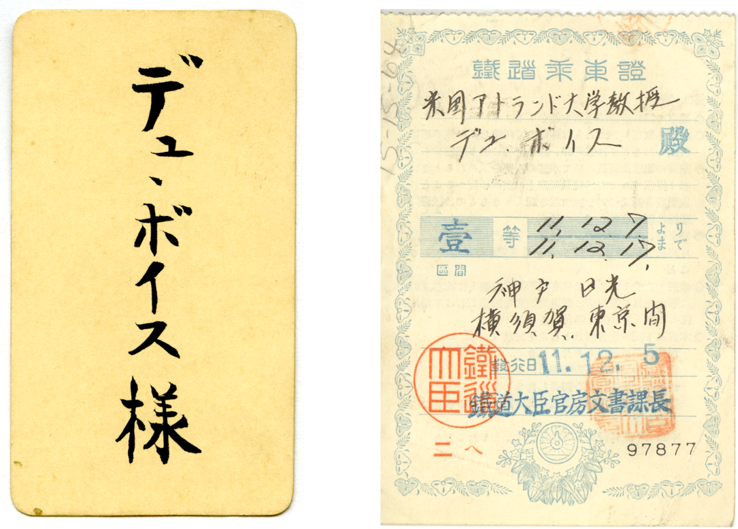
Card reading “Du Bois Sama,” or “Mr. Du Bois.” The honorific “sama” indicates formality and respect. All images courtesy of the W. E. B. Du Bois Papers at the Robert S. Cox Special Collections and University Archives at the University of Massachusetts-Amherst.
First class train ticket dated December 5, 1936 (Shōwa 11) permitting travel to Kobe, Nikko, Yokusuka, and Tokyo from December 7 to 17. Du Bois’s name can be found on the second line of handwriting.
Recognized today as a founding father of sociology, Du Bois was a lifelong researcher and educator, and a leading figure in the Pan-African Congress and the National Association for the Advancement of Colored People. He is best known for such works as The Souls of Black Folk (1903) and concepts like “double-consciousness” and “the color line,” landmarks in a body of research that aimed to strengthen political efforts for racial equality by theorizing what it means to live in a racialized world. Across a lifetime that spanned Jim Crow segregation, the Scramble for Africa, two world wars, an array of decolonization struggles, and the rise of actually existing socialism, Du Bois had much to study and to think about, and he wrote prolifically. He left few political stones unturned, including the rise of the Japanese Empire.
In his 1899 speech “The Present Outlook for the Dark Races of Mankind,” Du Bois remarked, “The one bright spot in Asia to-day is the island empire of Japan.” By the time he stepped foot in Japan in 1936, this conviction had only strengthened, despite Japan’s colonization of Taiwan, Korea, Manchuria, and elsewhere; and it crystallized upon his return to the United States, even amid the horrors of the Second Sino-Japanese War. In light of these imperial ventures, one might wonder, why was Du Bois so eager to visit Japan at all? If racial equality was a central aim of his life’s work, why did — or, we might say, how could — he take an affirmative view on imperial Japan? Taking a closer look at Du Bois’s controversial stance offers a chance to reflect on how we define empire, race, and solidarity, and to consider the relationship between research and political praxis.
Du Bois’s position on Japan is best approached through his broader body of anti-imperial thought. The nineteenth century witnessed both the emergence of democratic states and, paradoxically, violent and unabashed imperial expansion. Du Bois made sense of this contradiction through the concept of the color line, expanding on Frederick Douglass’s earlier use of the term. As he argued in a speech at the 1900 Pan-African Conference, “The problem of the twentieth century is the problem of the color line, the question as to how far differences of race … will hereafter be made the basis of denying to over half the world the right of sharing to their utmost ability the opportunities and privileges of modern civilization.”
Importantly, Du Bois understood the color line as a technique of division and domination that might be repurposed for revolutionary struggle. Vilashini Cooppan writes that the color line could function as “both problem and answer, both that which has historically divided darker from lighter, and that which will eventually link darker peoples together in a global alliance that ‘belts the world.’” In other words, Du Bois posited that racialization under empire might convene the very political coalition capable of winning liberation from empire: multi-racial, transnational, and facing a common imperial enemy.
In this vision, Du Bois believed Japan to be a national case worth watching and encouraging. To him, “yellow” Japan appeared to have “escaped the cordon of [the] color bar” — racialized but nonetheless unbowed — a feat “disconcerting and dangerous to white hegemony.” More, not just an exception to the color line, Japanese military and economic might appeared to offer an alternative and escape hatch to the color line’s hierarchy. Seok-Won Lee suggests that Du Bois engaged in “a projection of the future of non-white people onto Japan”: to him, Japan’s success in the modern era, and in the face of relentless Euro-American imperial expansion, seemed to be a bellwether for the democratic fates of the world’s non-white majority.
This view is outlined with most conviction in Du Bois’s writings from the 1930s. In “The Union of Color” (1936), for example, he asserted, “If the colored world wants to meet the white world on a plane of real equality and effective brotherhood, and without compromise and doubt evolve and establish a real union of all colors and races, then first of all the colored world must be a strong world, strong in its inner organization, strong in its power of thought and defense.” In Du Bois’s eyes, Japan had demonstrated such strength. In this same article, however, he cautions,
I do not want to supplement the hegemony of the white race with a tyranny of [B]lack folk or yellow folk or brown folk. I want the best of mankind to be able to work together for the development of all men. But I am not going to let my wish blind me into thinking that this object is accomplished if I give up my manhood and acquiesce spinelessly in continued suppression.
Here we see Du Bois encountering a certain paradox. On the one hand, it was necessary to contest an aggressively expanding world-system of white supremacist hierarchy. On the other, there was a risk of merely inverting or redirecting such a hierarchy, placing a new elite on top. This would reify the fiction of race, a fiction that Du Bois dedicated much of his academic life to debunking, and it would furthermore leave class inequality intact. What was the solution to these dilemmas? And how did a “strong” Japan fit into the picture of anti-imperial struggle?
To evaluate “the meaning of Japan,” as he titled a later speech, Du Bois seemed intent on actually visiting Japan. On the tail end of a fellowship in Nazi Germany in 1936, Du Bois got his chance to do so, arriving in Japan by way of Nagasaki and soon traveling eastward to the Kansai region, then to Tokyo. Thanks to the efforts of Hikida and the Society for International Cultural Relations — imperial Japan’s soft power arm — Du Bois saw much of Japan and met many Japanese people. He spent time with city, prefecture, and national leaders, as well as with university faculty and student groups, part of a busy schedule among academics, critics, journalists, and state officials. Du Bois’s time in Japan did not temper his enthusiasm for the so-called island empire. It left a strong impression, one that led to political clashes of heightening severity and stakes in the years before the US’s entry into the Second World War.
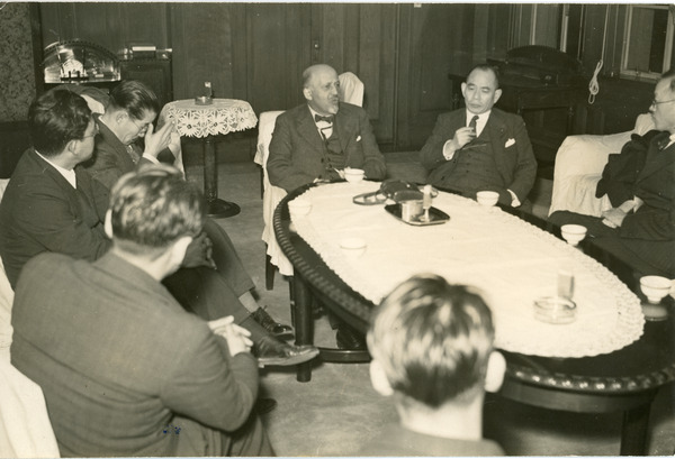
Photograph of Du Bois and Japanese academics in conversation in Tokyo, 1936.
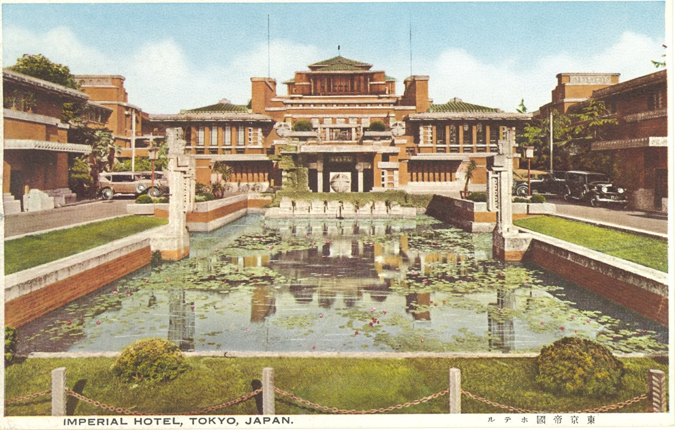
Postcard included among Du Bois’s personal effects from his 1936 trip. It depicts the courtyard of the second Imperial Hotel in Tokyo, designed by Frank Lloyd Wright, which was constructed 1919-1923 and demolished 1967-1968.
By the time Du Bois returned to the US in early 1937, he was no stranger to controversy as it concerned his views on Japan. He had explicitly supported its “Monroe Doctrine for China” on the grounds that it prevented European incursion into Asia. Concerning the 1931 Mukden Incident and subsequent establishment of Manchukuo — the name for Japan-occupied Manchuria — Sidney Pash writes, “Du Bois’s support for Japan throughout the Manchurian affair was forceful, unfailing and immediate.” This support was anchored in what Du Bois saw as a racist double standard with respect to Euro-American and Japanese foreign policies. Du Bois criticized that “England, France and America, gorged with the loot of the world, suddenly became highly moral on the subject of annexing other people’s lands.” He pointed out that when Japan entered Manchuria, “England held India, Hong Kong, half of Africa, and Australia; France had dominion over North Africa and Syria; the United States possessed half of Mexico, Puerto Rico, the Philippines, and the Canal Zone.” Du Bois had found further fuel for his fire in 1935 when Italy invaded Ethiopia without any condemnation by the League of Nations, which had rejected Japan’s demand for a racial equality clause at the Paris Peace Conference in 1919. Du Bois asserted, “Japan was right. The only path to freedom and equality is by force, and force to the uttermost.”
After the outbreak of the second Sino-Japanese War in the summer of 1937 and the horrific Nanjing Massacre in December, any claim that Japan was playing only defense in the imperial game lost much of what credibility it had. Yet, recently returned from Japan, Du Bois persisted. For the Pittsburgh Courier, he asserted, “It is to escape annihilation and subjection and the nameless slavery of Western Europe that Japan has gone into a horrible and bloody carnage against her own cousin [China] … The cause and the blame for this lies [with] all those white nations, that for a hundred years and more have by blood and rapine forced their rule upon colored nations.” With the signing of the Tripartite Pact in 1940, Du Bois defended — with a certain regret, but defended nonetheless — Japan’s joining with Germany and Italy. Reginald Kearney writes, “In [Du Bois’s] view, there seemed to be nothing Japan could do but seek alliance with the Axis powers, despite the fact that Germany despised yellow races, and Italy’s hands were ‘red with the blood of Africa.’”
Japan enjoyed relative favor among Black Americans throughout these decades — even after the attack on Pearl Harbor, according to Gerald Horne — but Du Bois’s position was an outlier. His assessment of Japan as the leader and guardian of non-white people appears to have calcified through his 1936 trip. In the face of increasingly fractious and ugly inter-imperial squabbling, Du Bois seems to have lost track of the dialectical conceptual purchase of the color line, such that he could and repeatedly did cast Japanese aggression as defense against white colonial domination and the conquest of its neighbors in Asia as solidarity.
As World War II and its consequences unfolded, Du Bois gradually retreated from this position. Japan had unmistakably defied the white supremacy of Europe and America, but this defiance proved only weakly adversarial to the forces of class and empire that this white supremacy enshrined. Du Bois’s writings from this postwar era, in particular the unpublished “Nippon: The Story of Japan” (1950), reflect this reevaluation.
The 1950s and 1960s saw a deepening and expansion of Du Bois’s internationalism. His ties to the anti-war and anti-nuclear movements strengthened, involved with the World Peace Council and the Japan Council against Atomic and Hydrogen Bombs. In public and private, he advocated fiercely for outlawing nuclear weapons. A 1955 letter indicates that Du Bois attended a performance of Hiroshima, of which he wrote, “Every American citizen should see it in order to realize how horrible war and especially atomic war can be.” In the anti-communist hysteria of the McCarthy Era, Du Bois was indicted as a foreign agent in part for this work opposing nuclear proliferation. Though acquitted, his passport was revoked from 1952 to 1958, limiting his international travel and internationalist work. In 1961, he relocated permanently to Accra, Ghana, at the invitation of President Kwame Nkrumah.
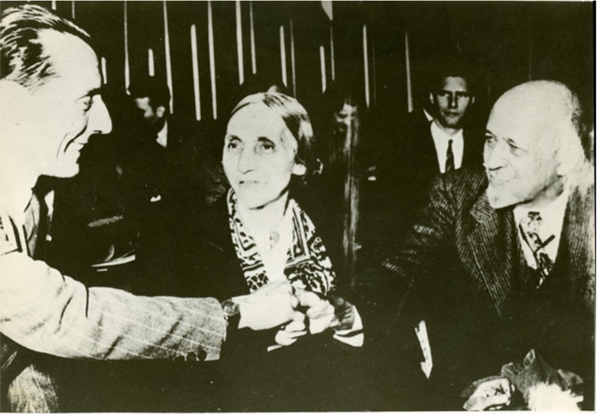
Photograph of Du Bois shaking hands with Frederic Joliot-Curie, President of the World Peace Council, at the World Peace Congress in Paris, 1949.
Du Bois died on August 27, 1963, at the age of 95. The following day, his wife and comrade Shirley Graham Du Bois received a letter from the Japanese Ambassador to Ghana: “Dr. [D]u Bois’s passing will be deeply mourned throughout Ghana — indeed throughout the continent of Africa — but the spirit of his personality will continue to inspire the leaders and masses of Africa on their way to complete emancipation and future progress.” One might wonder where Du Bois’s position on Japan fits into this spirit, his imperial apologism both present and absent in how he is remembered today.
It must be noted that even at the height of his enthusiasm for Japan, Du Bois expressed reservations concerning its embrace of “unbridled production” and reliance on “cheap labor,” which imitated and replicated the worst of European and American capitalism. These reservations qualified his stance, rooting for Japan’s anti-imperial potential rather than insisting upon its anti-imperial reality:
Japan forgets the danger of capitalism. … If Japan today, avoiding temptation, raised the standard of living among her laborers, she could still compete with the world and at the same time develop a mass of workers who would be the most intelligent and gifted the world has ever seen. Democracy would become possible in a great land based on a really intelligent people.
Equipped with domestic capital, skilled labor, and a state unafraid to fight the white powers, Japan held for Du Bois the capacity to realize the dream of a world democracy. Perhaps for Du Bois it was this capacity that mattered most: for Japan more than any other non-white nation, the chance to win a world beyond the color line had been possible.
This belief seems to have been shaped by Japan’s “Pan-Asianism” discourse and the related Greater Asia Coprosperity Sphere. Chief here is the 1942 “Overcoming Modernity” symposium, which convened thinkers from across the Japanese left and right to parse “Japan’s responsibility to ‘free Asia from Western colonial powers,’” as Yoko Arisaka describes, per Japan’s declaration of a regionally defensive Greater East Asia War in 1941. Within Pan-Asianism’s tangle of imperial and anti-imperial threads, Lee suggests that its “rhetoric of a harmonious multi-ethnic community” likely stood out to Du Bois, resonating with Pan-Africanism’s conviction in the necessity of a sphere beyond the reach of the European and American empires. In this light, Japan’s imperial relationship with the rest of Asia could easily look like yellow solidarity against white aggression, especially if Du Bois lacked access to the political and intellectual debates on the Japanese side, which John Krummel and John Maraldo argue were highly contentious even among the figures most associated with the empire and the war. More, Du Bois’s assessment betrays a misunderstanding of Japan’s complicated history with Western race ideology. He did not see that an aspiration to whiteness and the racialization of other Asian populations was at the core of the Japanese national project.
Japan first “entered Asia” — or was thrust into it — by way of Europe’s racialized continental schema of the world, which was introduced to Japan, along with the term “Asia,” in the early 17th century. Japan then “left Asia” by way of its own national self-construction as white during the Meiji period. As Ayelet Zohar writes, this process involved both “efforts to associate itself with Euro-American processes, developments and racial discourses” and “the act of identifying nations and ethnic groups that were ‘lesser,’ or ‘inferior’ to Japan.” Such terms were applied to Korea, Manchuria, and farther-flung neighbors, as well as to territories and populations included in Japan’s borders still today, such as Ainu Mosir (Hokkaido) and the Ryukyu Islands (Okinawa). Processes of racialization, both enforced and embraced, multiply contested and repurposed, were as intimate to Japan’s empire as any other. Adom Getachew and Jennifer Pitts suggest in their volume on Du Bois’s international thought that “Du Bois had little grasp of these dynamics.”
It seems that Du Bois’s understanding of the color line did not shift in attunement to the racial and imperial formations of the interwar period. While Japan was certainly regarded as a colored nation by the white empires, its own development of a kind of Pan-Asian racial theory followed these imperial footsteps but with a different color hierarchy. From the viewpoint of the Euro-American world, Japan could be plausibly seen as a geopolitical underdog or guardian of non-white people, while at the same time enforcing another color line within its own imperial dominion, one less intelligible to the outside. If Du Bois was at his best “a thinker who wrestles with empire in time,” as write Getachew and Pitts, his thought suffered from something of a historical lag in its wrestle with Japan, failing to apprehend Japanese Pan-Asianism as an imperial formation both racist and capitalist in character. He saw anti-imperialist struggle in what is better described as an inter-imperialist struggle, one that both incorporated and in part transcended the racial politics that the white supremacist empires had set in motion long before the rise of Japan’s own empire. In accusing the Euro-American powers of a double standard in their treatment of Japan — a reasonable and righteous assessment — Du Bois overlooked a certain double standard in his own thought.
Throughout his life, in both research and praxis, Du Bois’s commitment to multi-racial and international solidarity was sincere. Across decades of exploitation, violence, and the relentless struggle against these forces, the analytical sophistication of Du Bois’s commitment grew to match its sincerity. The lessons of Japanese imperialism were surely indispensable to this process.
Claire Ravenscroft is Associate Professor of American Literature, American Studies, and Environmental Studies at International Christian University in Tokyo, Japan.
This research was supported by the Japan ICU Foundation.