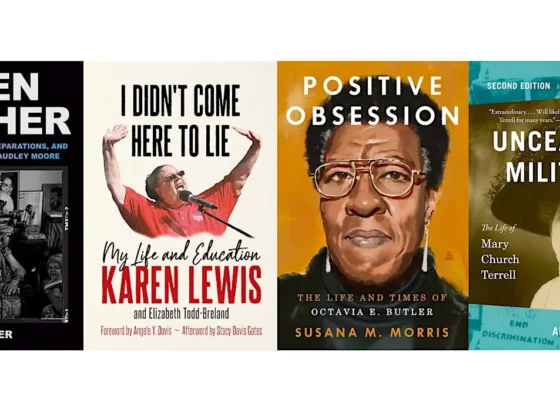
Conversations in Black Freedom Studies (CBFS) is a free public education series hosted by the Schomburg Center for Research in Black Culture. In connection with the online event on Black Women and Biography on Thursday, September 3rd, CBFS media fellow Lucien Baskin interviewed four of the guest speakers: Susana M. Morris, author of Positive Obsession: The Life and Times of Octavia E. Butler, Elizabeth Todd-Breland, co-author with Karen Lewis of I Didn’t Come Here to Lie: My Life and Education, Ashley D. Farmer, author of Queen Mother: Black Nationalism, Reparations, and the Untold Story of Audley Moore, and Alison M. Parker, author of Unceasing Militant: The Life of Mary Church Terrell.
Conversations in Black Freedom Studies (CBFS): What led you to write about the lives and work of Octavia Butler, Karen Lewis, Queen Mother Moore, and Mary Church Terrell?
Susana M. Morris (SMM): I have been a huge fan of Octavia E. Butler since I first encountered Parable of the Sower thirty years ago. Over the years, I’ve taught her work and seminars many
times, but I wanted to know more about her life, more about what drove her work. Getting the opportunity to spend time in her archive allowed me to do that. I began working on Positive Obsession in earnest in 2020, right before the world shut down. During that early lockdown it, was clear to me that her life story was particularly timely and I set out to write about Butler’s life and work for both readers who enjoy her work as much as I do and to introduce her to new audiences.
Elizabeth Todd-Breland (ETB): I will forever be honored that Karen Lewis entrusted me to co-author her memoir—I Didn’t Come Here to Lie: My Life and Education. Karen was a formidable fighter and staunch defender of teachers, students, and public education. She’s best known for leading the Chicago Teachers Union (CTU) to a historic 2012 strike, challenging establishment political leaders, and paving the way for an unprecedented wave of teacher strikes nationally in the decade that followed. In 2017, Karen and a dear friend, editor Jill Petty, asked me to help Karen write her memoir. The initial plan was for Karen to write her story, and I would contribute by putting her story in a broader historical context. Unfortunately, several months after we started working together, Karen had a stroke. She was unable to continue writing, but she was able to speak. So, we shifted and recorded more than a dozen long-form, multi-hour conversations to generate original content for the book. After her untimely death from cancer in 2021, I used the content from these conversations, Karen’s other public writing and speeches, and archival and media sources to finish the book. Until the very end, Karen was spirited, unshakeable, and fierce. She is inspiring and remains a model for organizers and teachers doing the day-to-day work of building a better world.
Ashley D. Farmer (ADF): While researching my first book, Remaking Black Power, I kept hearing one name over and over again: Queen Mother Moore. People described her as a commanding presence at every major movement moment in 20th-century Black history. She was said to have known radical Black icons like Marcus Garvey and Malcolm X and was widely credited as the founder of the modern reparations movement. I soon realized that if we understand Rosa Parks to be the mother of the Civil Rights Movement, then Audley Moore midwifed modern Black Nationalism.
But despite her enormous influence, I was stunned to find that there were no full-length biographies, no documentaries, no major media features, and only one or two academic articles about her. I soon figured out why. Although she lived for nearly a century and took great care to document her own life, Moore has no formal archive. The records of her contributions were scattered, lost, or, in some cases, stolen. She was central to shaping the Black Freedom Movement, yet her legacy had been all but erased from public memory.
So I made it my mission to reconstruct her story and uncover the full sweep of her life and activism. What I found astounded me. Here was a woman who, for the better part of a century, set her compass toward a vision of Black Nationalist liberation and moved doggedly toward it. She formed alliances and, when possible, joined seemingly oppositional organizations to survive, but never relinquished her vision. The result is a biography of an incredible woman, but also a history of the Black Freedom Struggle from the vantage point of grassroots Black women who propelled it forward.
Alison M. Parker (AMP): I first became interested in Mary Church Terrell when I was writing an earlier book on Black and White women’s political thought in the 19th Century. My last chapter was on Mary Church Terrell, who was elected as the first president of the National Association of Colored Women’s Clubs in 1896. Terrell was a prominent supporter of Black voting rights whose political thought had not been fully analyzed by scholars. I planned to read as many of the biographies written about her as I could, in order to put her ideas into the context of her life and history. But I found that there were no biographies of Terrell written for adults, although there were at least a dozen biographies written for children and youth! That’s part of what started me on my path to being her biographer.
I was also inspired by my mother, Joanne Parker, who was an early pioneer in women’s studies and a local and statewide organizer in California for a wide range of social justice causes. Her experiences helped me see the complexities and value of political struggle. As a young White woman from the Midwest, she began her first teaching job at the Woman’s College of the University of North Carolina, Greensboro, in 1961, the year after the sit-ins began there. In the Deep South at a volatile moment in the Civil Rights Movement, my mother supported her students in boycotting, picketing, and integrating the main street near the campus, even if that meant she also had to endure hostility and harassment from her colleagues. Once in Los Angeles in the early 1970s, she attended rallies at UCLA organized by the Committee to Free Angela Davis and later introduced me to an intersectional feminism that has informed my scholarship.
CBFS: How does Black feminism transform the practice of life writing, and what tools does biography offer to Black feminism?
SMM: Black feminist theoretical frameworks unsettle dominant narratives and reconfigure the boundaries of biography by centering the lived experiences and epistemologies of Black women and interrogates historical silences and challenge the archival practices and institutional structures that have long marginalized Black voices. On the other hand, biography underscores how Black feminism is not simply a lens to understand large structures of power, but also a magnifying glass on the self.
ETB: The practice of Black feminist life writing requires rigor and care. The Combahee River Collective Statement discusses how Black feminism necessitates an expansion of the principle that “the personal is political” and develops an “integrated analysis and practice based on the fact that the major systems of oppression are interlocking.” This conceptual and analytical frame is central to the praxis of Black women’s life writing. As a form of creative nonfiction, memoir is a particularly fitting genre to engage an expansive notion of the personal as political. Karen Lewis was a larger-than-life public and political figure. But she wanted to write her memoir to share her personal life story and allow people to feel closer to her; to feel her humor and experience her sharp political analysis. She wanted her memoir to inspire the next generation of organizers and leaders (“to make space for other people to come through behind me”), to share the lessons she learned fighting against interlocking systems of oppression, and fighting for Black women, communities of color, educators, workers, children, and public education for the public good. Black women’s life writing is methodically creative and ambitious, while making important contributions to the archive of Black women’s lives and history.
ADF: Black feminism transforms biography by exposing the limits of the traditional biographical form, or what many would see as the cradle-to-grave approach, built on the idea or assumption that one can write the full life of a singular subject. That model was built with white, usually male, lives in mind and, perhaps most importantly for the researchers, lives that were valued, documented, and preserved. Black women’s lives, by contrast, have often only been recorded or kept through traces of violence: property ledgers, FBI files, court records, etc., if they have been kept or recorded at all. A Black feminist approach to biography takes this absence as a starting point rather than something to be avoided or to write around. Thus, it makes room for the messiness and contradictions of human life and takes the gaps and the unknown as historically meaningful evidence of the very systems of erasure that Black women subjects endured.
Biography helps us take Black feminist principles and apply them to an embodied life. It allows researchers to move beyond the larger tropes and theories that define the field and show how the systems that those theories describe actually play out at the daily level. It is a form that allows us to foreground a subject’s choices, relationships, resistance, and inner lives amid the structures and systems that Black feminism defines and illuminates.
AMP: Mary Church Terrell, along with her Oberlin classmate Anna Julia Cooper and a handful of other Black women intellectuals at the turn of the 20th Century, were part of a long genealogy of Black feminist thinkers who articulated ideas that Kimberlé Crenshaw later deemed the theory of intersectionality. Terrell identified herself as “a colored woman in a white world” who experienced the interconnected oppressions of racism and sexism throughout her life: “A white woman has only one handicap to overcome—that of sex. I have two—both sex and race. I belong to the only group in the country which has two such huge obstacles to surmount. Colored men have only one—that of race.”[1]
Black feminism offers a deeper, more nuanced, intersectional understanding of how Mary Church Terrell’s private life influenced her reform and policy advocacy. In the 1890s, Terrell tragically suffered a late term miscarriage, a still birth, and the death of a two-day-old baby in a segregated hospital in Washington, D.C. These traumatic experiences of loss informed her priorities when she was elected as the first president of the National Association of Colored Women in 1896. Terrell advocated day nurseries for the children of working Black women and raised money for free kindergartens for Black children. She also publicly highlighted statistics revealing disproportionate Black infant and maternal mortality rates. In her presidential speech at the NACW’s 1897 Nashville convention, Terrell encouraged Black women to pursue higher education, including nursing and medical degrees so that they could become medical professionals with a vested interest in providing high-quality health care to their community. These policy and reform priorities addressed the needs of all Black women, regardless of class, who all faced health, education, and employment disparities.
CBFS: What is one lesson from the lives of the women you write about that resonates with you today?
SMM: I am going to have to cheat and offer two lessons. One, Butler exemplifies how one can live a life of the mind outside of the ivory tower. She invites all of us to consider how staying curious, taking the world around us seriously, and recognizing patterns is something that anyone can and that everyone should do. Two, and relatedly, Butler personifies persistence even when your talent or hard work is not always recognized. Her example of “positive obsession” reminds us that our work and our art, whatever that may be, is vital—whether or not it is published or exhibited. The desire to create, to express yourself, is reason enough. This is a powerful message in a world that would have us think that creativity must be tethered to capitalist productivity.
ETB: It’s hard to pick just one. Karen Lewis left us many lessons that speak to our current moment—as a Black woman who fought for public education as a public good, challenged billionaires, built solidarity in multiracial coalitions, and struggled against establishment politicians–locally and nationally. Karen had two sets of question that she often came back to, and that I find myself coming back to as well. The first is a set of questions about power that she posed to assess policy: “Who are the winners and losers? Who makes the rules to the game? What stories do the winners tell the losers that keep them playing the game?” The second is a set of questions she asked when faced with strategy decisions to build solidarity: “Does it unite us? Does it build power? Does it make us stronger?” Solidarity doesn’t mean we are all the same. It means showing up for each other. It means seeing each other’s humanity. It means standing together and fighting back in the face of injustice. Karen Lewis was a freedom fighter, and she taught us how to fight. In these difficult times, we have much to learn from her brilliance, humor, courage, and commitment to fighting for and building a better world.
ADF: One of the things that writing about Moore has taught me is that it is important to stay the course. Moore defined her value system and her vision of Black liberation early in life and stuck with it even as the world changed around her. At times, like when she was supporting reparations in the late 1950s and early 1960s, she seemed like an outlier. At other moments, her ideas, like Black pride and connection to Africa, were popular. But Moore never wavered, and as a result, she lived a fulfilled life where she was true to herself and one in which many of her ideas, like reparations, have gained widespread support. Whether or not you agree with her politics, her life is a lesson in how to stay the course. How to hold fast to values, even when it feels like everything around you is shifting. In a time when it’s easy to feel overwhelmed or cynical, I find her story grounding.
AMP: One lesson from Mary Church Terrell’s life comes from Paul Robeson’s eulogy of her as an “unceasing militant” struggling “for the full citizenship of her people.” By bringing together two words that seem to be in tension, Robeson highlighted an aspect of Terrell’s life history of activism that matters today. Social justice work for change can be militant and unceasing–continuous, slow, and often undramatic. Terrell persevered even when there were no clear signs of progress and when the violence and White backlash against African Americans could have been overwhelming. Terrell was not a one-cause activist. Instead, she joined multiple organizations and worked on a number of causes, from antilynching legislation, the expansion and protection of Black men’s and women’s voting rights, desegregation, and so much more. Mary Church Terrell’s unceasing determination to participate in the long arc of activism is a lesson we can all learn from.
Author Biographies
Susana M. Morris is a Black feminist scholar and a cultural critic. She is an associate professor of Literature, Media, and Communication at Georgia Tech and the co-founder of The Crunk Feminist Collective. A former Anschutz Distinguished Fellow at Princeton University and Norman Freeling Visiting Professor at the University of Michigan, she is the author of Positive Obsession: The Life and Times of Octavia E. Butler. Her other works include Close Kin and Distant Relatives: The Paradox of Respectability in Black Women’s Literature, the co-edited collection The Crunk Feminist Collection, and the co-authored young adult handbook Feminist AF: The Guide to Crushing Girlhood. Her writing has appeared in journals such as The Black Scholar, Signs: Journal of Women in Culture and Society, and Tulsa Studies in Women’s Literature, and she has been featured in venues such as NPR, the BBC, the New York Times, the New Yorker, the Washington Post, and Essence. She is currently at work on several projects, including a co-edited companion to Octavia E. Butler, a monograph on the enduring significance of the Black vampire in literature and popular culture, and a literary history of Black autodidacts.
In her research and teaching, Elizabeth Todd-Breland focuses on 20th century United States urban and social history, African American history, and the history of education. Her work also explores interdisciplinary issues related to racial and economic inequality, urban public policy, neighborhood transformation, education policy, and civic engagement. Her book, A Political Education: Black Politics and Education Reform in Chicago since the 1960s (University of North Carolina Press, 2018), analyzes transformations in Black politics, shifts in modes of education organizing, and the racial politics of education reform from the 1960s to the present. Professor Todd-Breland’s writing has appeared in the Journal of African American History, Souls, and scholarly edited volumes. She has also contributed to popular outlets, including NPR, ESPN, the Washington Post, and local radio, television, print, and online media. Her research has been supported by grants and fellowships from the National Academy of Education, Spencer Foundation, Andrew W. Mellon Foundation, American Council of Learned Societies, Social Science Research Council, Ford Foundation, and UIC Institute for Research on Race and Public Policy. Professor Todd-Breland earned her Ph.D. in History from the University of Chicago.
Ashley D. Farmer is a historian of black women’s history, intellectual history, and radical politics. She is currently an assistant professor in the Departments of History and African and African Diaspora Studies at the University of Texas at Austin. Her book, Remaking Black Power: How Black Women Transformed an Era is the first comprehensive intellectual history of women in the black power movement. The book introduces new and overlooked women activists into the history of black power, examines the depth and breadth of their political and intellectual engagement, and shows the relationship between women’s gendered theorizing and the trajectory of the black power movement. She is also the co-editor of New Perspectives on the Black Intellectual Tradition, an anthology that examines four central themes within the black intellectual tradition: Black internationalism, religion and spirituality, racial politics and struggles for social justice, and black radicalism. She is also the author of several articles about African American women’s black power activism and intellectual production, and her research interests include African American history, gender history, and intellectual history. She is a graduate of Spelman College and holds a Ph.D. in African American Studies and an M.A. in History from Harvard University.
Alison M. Parker is the Richards Professor of American History. She has research and teaching interests at the intersections of gender, race, disability, citizenship and the law in U.S. history. She majored in art history and history at the University of California, Berkeley, and earned her Ph.D. from the Johns Hopkins University. In 2017–2018, Parker was an Andrew W. Mellon Advanced Fellow at the James Weldon Johnson Institute for the Study of Race and Difference at Emory University, where she worked on her biography of the civil rights activist and suffragist Mary Church Terrell, Unceasing Militant: The Life of Mary Church Terrell. Her op-ed “When White Women Wanted a Monument to Black ‘Mammies,’” appeared in the New York Times. Parker is also the author of two historical monographs, Articulating Rights: Nineteenth-Century American Women on Race, Reform, and the State and Purifying America: Women, Cultural Reform, and Pro-Censorship Activism, 1873–1933. She has co-edited three anthologies and authored numerous articles and book chapters. Her most recent article is “Oscar Stanton DePriest: Republican Politics, the Strategy of Non-Partisanship, and the Struggle for Civil Rights.” Parker is now working on a new book on a social movement organizer, the civil rights activist Mary Hamilton, who served as field secretary and Southern Regional Director for the Congress of Racial Equality (CORE) in the early 1960s.
[1] Mary Church Terrell, A Colored Woman in a White World (Simian, 1940, reprint 2006), 93.