By Nadja Eisenberg-Guyot
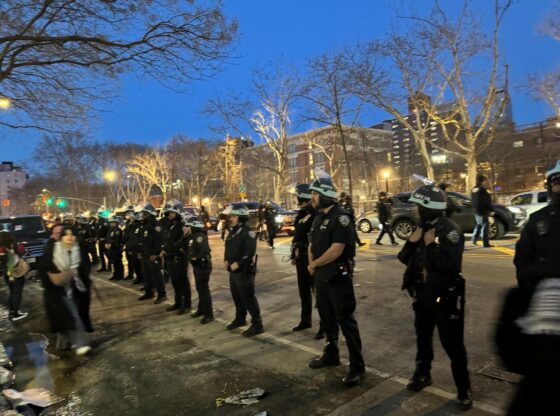
On April 30, 2024, the 206th day of the genocide in Palestine, we stood chanting with hundreds outside Columbia University as theNYPD violently raided Hind’s Hall (liberated by The People of Hind’s Hall) with drawn weapons and armored trucks. Representing an escalation of police violence on Columbia’s campus not seen for decades, the raid on Hind’s Hall nonetheless conjured other scenes: weapons, tactics, and propaganda normalized in the so-called “war on drugs” and “war on terror.” In the early months of 2025, we are again witnessing the escalation of state violence at the intersection of these perpetual wars, as the Trump Administration nearly-simultaneously kidnapped Palestine solidarity organizer Mahmoud Khalil using terrorism as alibi and three hundred Venezuelans slandered by Drug War propaganda as “gang members.” Although not typically held in the same analytic frame, drug war tactics and political repression shape each other, and political prisoners like Khalil and drug war prisoners like the Venezuelans now captive in El Salvador’s notoriously brutal prisons share a linked fate.
Drug war policing is shaping the repression of the Palestine solidarity movement in Turtle Island. As organizers and scholars have noted, this is longstanding practice. Drug war wiretapping and war on terror surveillance are routinely turned against social movements, like the George Floyd rebellions. Examples like this reveal that, just as in Nixon’s day, the war on drugs is an intentionalwar on the Black and anti-imperialist left. But more broadly, the drug war has deeper roots in securing U.S. settler-colonial,imperialist, and racial capitalist interests domestically and abroad. The specific mechanisms and tactics of drug war policing are important, but undertheorized, aspects of this dynamic. Thus, in this essay, I lay out five ways that drug war policing is being turned against the Palestine solidarity movement.
Drug Policing as Occupation: A Brief Overview
Prohibition is an alibi for imperial and settler colonial violence. At the end of the 19th century, just as racist drug panics were an ideological vehicle for anti-Black, anti-Indigenous, and xenophobic state violence within the expanding boundaries of the U.S. settler colony, drug control was central to U.S. colonial power in the Philippines, Cuba, Hawaii, and Puerto Rico. Architects of so-called “native” policing in U.S. colonies returned home and elaborated the modern surveillance state and municipal police forces. Then and now, the construction of the racialized, nebulous, and contagious “drug scourge” is central to the consolidation of police power, federal law, and the global reproduction of race.
Over the last fifty years, the war on drugs has led to a dramatic expansion of police power in the U.S., including police militarization, new technologies that obscure racist police violence through the fiction of “data driven” policing (CompStat, ShotSpotter), and ever-expanding police impunity and “limitless discretion.” The US police and the IOF (Israel Occupying Force, sometimes known as the Israel Defense Force, IDF) are expected partners in innovating these drug war tactics to maintain racist state violence. For example, in 2016, the Knesset passed a Stop and Frisk law modeled on the NYPD’s unconstitutional practice and relying on the CompStat program. Implemented in 1994 under Police Chief William Bratton, CompStat harnessed new technology to the centuries’-long practice of visualizing crime as a problem of Blackness. Stop and Frisk and CompStat work the same way in Palestine as they do in the U.S. drug war: to systematize occupation. Reciprocally, the NYPD modeled its now-infamous “Demographics Unit,” a secret program to monitor Muslim communities after 9/11, on Zionist monitoring of Palestinians in the West Bank. More than just modeling, municipalities across the U.S. send police to train in occupied Palestine; Atlanta’s much-opposed Cop City is modeled on the IOF’s “Mini Gaza” facility. Just as the war on drugs consolidates anti-Black and anti-Indigenous surveillance and punishment that are adopted by the Zionist entity, the occupation of Palestine coheres new tactics of mass surveillance and border violence gladly adapted by U.S. police, border patrol, and colleges and universities.
Since 2007, the Palestinian Authority (PA) has been enrolled in the U.S.-sponsored global drug prohibition regime, no doubt forced by the bind of governance under occupation, in which the PA has, in Noura Erakat’s words, “internalized the colonial logic that its compliance […] will be rewarded with independence.” Regarding the global war on drugs, the PA collaborates with the U.S. Department of State’s Bureau of International Narcotics and Law Enforcement (INL) (as well as the Zionist entity, demonstrating how policing in the West Bank, like elsewhere, secures settler-colonial interests). Although allegedly focused on drug law enforcement, the INL’s “partnership” with the P.A. has resulted in anti-protest “riot control units” and the training and equipping of the National Security Force and Palestinian Civilian Police to undertake SWAT operations against targets construed along classic drug war lines: “suspected terrorists, militants, and dangerous criminals.” This reveals how racist drug war and war on terror narratives converge in the powerful fiction of the “narcoterrorist.”
Criminalizing Survival
Drug war propaganda justifies police crackdowns on homeless encampments in the name of eradicating drug use, implementing public health, law and order, having compassion for houseless people, and containing (or eliminating) disorder. In similar fashion, police and university propaganda represented student encampments as dangerous, unsanitary nuisances, paving the way for violence. Last spring’s “sweeps” against student encampments—the razing of collective life in solidarity with Palestine—were modeled on anti-homeless policing, tactically as well as ideologically. And the global resonances are horrifying: The use of bulldozers to maim and kill houseless people like Cornelius Taylor in Atlanta resonates horrifically with the use of caterpillar bulldozers in Palestine to maim, kill, and dispossess—yet another instance of the settler-colonial need to value property and order over the lives of oppressed people and those who organize in their defense.
A month after the first wave of student encampment sweeps (in June, 2024), the Supreme Court’s decision in City of Grants Pass, Oregon v. Johnson deemed constitutional a cruel anti-camping ordinance, paving the way for escalating state violence against homeless people and the student intifada. In Grants Pass, Gorsuch’s majority opinion made explicit reference to student encampments, asserting that Grants Pass’s anti-camping ordinance did not criminalize homelessness per say because it “makes no difference whether the charged defendant is homeless, a backpacker … or a student who abandons his [sic] dorm room to camp out in protest on the lawn.” Although not immediately obvious, and largely passed over in public commentary, the drug war is the hidden legal backdrop for the Court’s decision.
Grants Pass is the latest assault on the 1962’s California v. Robinson, a landmark case in which the Supreme Court’s ruled so-called “status crimes” unconstitutional. In Robinson, the Court found that California’s statute criminalizing the mere status of being a narcotics user (versus the behaviors of possessing, selling, or using drugs) violated the 8th Amendment prohibition on cruel and unusual punishment, paving the way for the repeal of statutes across the country that had criminalized vagrancy (possessing no fixed address), habitual drug use, unemployment, and other statuses. Robinson’s legacy is complex, but its near-total effacement in the drug-war-fueled decades since make clear that the Court desires police to avail themselves of an old, and longstanding, drug war tactic: the criminalization of statuses obscured through the legal fiction that what is at stake is behavior, not being. Thus, the figure of the student in Gorsuch’s opinion asserts the status-neutrality of an anti-camping ordinance that is anything but status neutral. In the immediate wake of Grants Pass, jurisdictions (as well as universities and colleges) have raced to prohibit camping, revealing the cryptic legal construction of a new criminalized status—being a pro-Palestine student (perhaps in a tent)—alongside anti-camping laws’ longstanding targets.
Criminalizing Social and Cultural Life
Alongside criminalizing homelessness, laws targeting mutual aid and collective life attack the social networks through whichcriminalized people (especially sex workers, drug users, incarcerated people, and poor people) survive disposability. This all-out assault on the survival of poor and working class people of color is enhanced by gang policing and conspiracy charges—yet more drug war policing aimed at liberations movements today. In ongoing crackdowns on the Palestine solidarity movement, the state will continue to pursue and expand these tactics. The systematic criminalization of poor people of color’s movement, aesthetic production, speech, and social relationships predict the onslaught of anti-Palestinian repression in the U.S.
For example, in 2023, Georgia’s Attorney General used the state’s RICO Act to charge 61 Stop Cop City protestors—who have been assiduously drawing the links between the Zionist Entity and U.S. violence—as part of a “criminal conspiracy.” (Some of the charges relating to money-laundering were dropped on September 17, 2024.) While coverage of these and similar indictments often express astonishment that laws “intended to combat organized crime” are being used to punish protest, leftwing media reporting on the Stop Cop City indictments noted the prosecutions bore a striking resemblance to the First Red Scare. Less attention has been paid to howthese strategies of collective prosecution and punishment take their most well-developed form as “gang” prosecutions and other laws criminalizing the social networks, cultural production, and collective lives of working class people of color.
While the legal history of RICO statutes is complex, its expanded use as a technology of the drug war is undeniable. As Donna Murch argues, the use of RICO to effect the slippage between working class people of color, “gangs” and “terrorism” was a “defining principle of the Reagan-Bush era war on drugs,” the reverberations of which we still experience today. Under the strategies of collective criminalization and punishment enabled by conspiracy charges, police and prosecutors use social networks (traced through Facebook and Instagram posts, kinship networks, texts, and wiretaps) and aesthetic production (zines, song lyrics, clothing colors, fashion, tattoos, graffiti and mural art) as evidence of gang membership.
Regarding sonic and lyrical cultural production, The use of rap lyrics in criminal prosecutions prefigured House Resolution 883’s absurd construal of “from the river to the sea” as a call for genocide. The criminalization of visual art supporting Palestinian liberation equally takes inspiration from the drug war. For example, in November, 2024, more than a dozen police officers and a member of the FBI’s “Joint Terrorism” task force raided the home of two George Mason student organizers, allegedly looking for evidence in an ongoing investigation of pro-Palestine graffiti on GMU’s campus. Although rare for “phalanxes of police officers” to respond to allegations of “spray painting” on a college campus, as National Students for Justice in Palestine argued at the time, the so-called “war on graffiti”–an offshoot of the war on drugs and gang and broken windows policing–has long been a vehicle for police militarization. (Too, these tactics extend those long used against Palestinian students in Zionist universities and colleges, whose expressions of Palestinian national identity, let alone resistance, are routinely and violently suppressed.)
Beyond gang policing and surveillance, the drug war has produced new forms of collateral punishment now threatening participants in the student intifada. As X user PalmTreesnGz pointed out, the federal government’s recent gesture towards potentially restricting access to federal benefits like student loans and loan relief on the basis of participation in the Palestine solidarity movement is a drug-war tactic, mimicking the structure of a gang injunction and the collateral consequences (like loss of housing, and benefits restrictions) routinely imposed on people with drug convictions. Gang injunctions are a particularly insidious form of criminalizing social life, as they render illegal ordinary activities of social life: wearing certain colors, hanging out in certain neighborhoods, spending time with certain people, or being out past “curfew.”
“Alternatives” That Are Anything But
Alongside outright force, the drug war has innovated alternative forms of surveillance and prosecution in which criminalized people—having already been subjected to the violence of arrest, charging, and pretrial detention—are forced into plea deals incumbent upon mandatory therapeutic intervention. Universities have taken up this tactic to impose behavioral modification and other “lesser” sanctions upon participants in the student intifada. For example, in May 2024, as Manhattan D.A. Alvin Bragg dropped the criminal prosecutions against encamped NYU students, NYU imposed mandatory “reflection papers” and a series of “ethics” modules developed by Symplicity Corporation, a private educational technology company owned entirely by private equity firm H.I.G. Capital and offering, among other “services,” “behavioral intervention management.” Symplicity cheerfully encouraged students to view the modules as edifying: “while you are completing this project as a sanction … we hope that you will find this experience both educational and beneficial for your daily life.” This is an intensification of the “elite capture” of transformative and restorative justice, in which models for addressing interpersonal harm outside the carceral state have been coopted, institutionalized, and commodified. Under these terms, subjection to the violent rule of law is re-framed as “help” and Symplicity’s profit motive in proffering these alternatives is obscured.
Like the pseudoscientific behavioral modification programs offered to drug war defendants and incarcerated people as “treatment,” Symplicity’s modules framed participation in the student intifada as the result of individual deficit and “criminal thinking patterns.” The modules prevented students from defending as ethical their encampment, instead demanding that students rehearse a litany of moral failure. While much ridiculed, NYU’s ethics modules recapitulated the mundane exercise of judicial authority in drug courtsand other “problem solving courts,” where defendants have little choice but to surrender their own agency and narrative authority if they hope to be released from court supervision. Yet defendants’ abrogated claims to self-expression, movement, and association are rarely held in the same analytic frame as attacks on freedom to speak on Palestine. Just as there are lessons from the drug war for the repression of student protest, there are lessons from the pro-Palestine movement for defending the drug war’s survivors.
Conclusion
There are many ways to understand how, in Nadine Naber’s words, “The U.S. and Israel Make the Connections for Us”: how the global structures of anti-Black, settler-colonial violence link occupied Turtle Island to occupied Palestine. In this piece, I have focused on how, through the long war on drugs, the settler-colonial, racial-capitalist state has innovated techniques of repression.
Meanwhile, the drug war’s survivors—racialized working class people, immigrants, so-called gang members, people who use and sell drugs, homeless people, and sex workers—are treated as disposable and thus as appropriate and invisible targets of state violence. We must make common cause with our criminalized, incarcerated, and detained community members, most of whom are not popularly understood as political prisoners, yet who have long been at the forefront of resisting state violence. Their determination and capacity to struggle under conditions of captivity, extreme brutality, and relentless surveillance are a model for us all. The Palestinian liberation movement knows this well. If, as Ashjan Ajour has recently argued, “incarceration is a defining feature of the settler-colonial project,” then imprisoned Palestinians–and imprisoned colonized people worldwide–are necessarily and materially at the forefront of liberation movements. In our failure to reckon with how many of the policing tactics arrayed against the Palestine solidarity movement today originated in the well-oiled machinery of the drug war, we embolden imperialists, genocidaires, and settler-colonists. Tracing these connections is critical to forging solidarity and collective struggle among empire’s ever-expanding targets, while continuing to center criminalized people and prisoners who have the most to teach us about, and the most to gain from, the struggle against violence and captivity.
AUTHOR BIO
Nadja Eisenberg-Guyot is a cultural anthropologist whose work focuses on how criminalized people who use drugs envision healing, transformation, and solidarity outside the carceral state and forced cure. They would like to thank Vani Natarajan for their editing, research, and, most importantly, being an invaluable collaborator and interlocutor as the themes of this paper were worked out, and being a steadfast, principled comrade in the fight for Palestinian liberation.