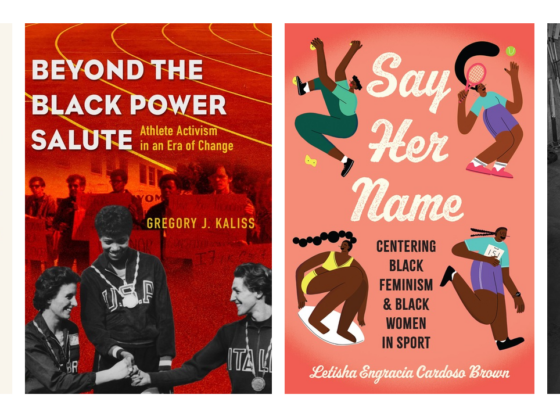
Conversations in Black Freedom Studies (CBFS) is a free public education series hosted by the Schomburg Center for Research in Black Culture. In connection with the online event on Sports and the Black Freedom Struggle on Thursday, November 5th, CBFS media fellow Lucien Baskin interviewed four of the guest speakers: You can register here to attend this free virtual event.
Conversations in Black Freedom Studies (CBFS): What led you to write your recent books?
Letisha Engracia Cardoso Brown (LECB): Studying sport was not my intention when I began graduate school in sociology at the University of Texas. To be honest, I didn’t know much about sociology, period (at least, I didn’t think so). I earned my B.A. in Africana Studies from the University of Northern Colorado (Greeley, CO). What I loved about my BA program was that it was interdisciplinary, drawing from culture, history, art, literature and ideas of people of the African diaspora. As I moved through my program, I came across the work of Dr. Patricia Hill Collins, over and over, and after learning about her academic training, I decided that I would get a MA/PhD. in sociology. So, I entered grad school with a theoretical understanding of Black feminism (at least to an extent). It was my interest in Black feminist thought specifically, and my that eventually led me to my work on Black sportswomen. My work began with a course paper on race, representation and sports by examining media discourse around the South African runner Caster Semenya.
In 2008, Semenya won the 800-meter dash during the World Championships in Berlin, Germany. What could have and should have been a moment of celebration the then 18-year-old Semenya was thrust into a media maelstrom around global understandings of gender and sexuality. While working on this paper, which eventually became my MA thesis, I realized how much of our daily experiences are reflected and amplified within sport as a social cultural institution. My research took a pivot in grad school (as it often does), but I always seemed to come back to the critical study of sport; and more and more, a Black feminist study of sport. Say Her Name as a title was intentionally tied to the social movement of the same work, and the earlier work of Kimberle Crenshaw. It is also my attempt to use sport to theorize gender and sexuality, anti-Blackness, and representation grounded in Black feminist thought. I wrote it to be the book that would’ve sparked my interest as a student, one still wrestling with what to study. So, Say Her Name really, is a love letter to my earlier self, and the foundation of more work to come.
Gregory Kaliss (GK): I wrote this book because I am interested in sports and activism, and I was especially intrigued by the time period of the mid-1960s through the mid-1970s. That’s a time when a number of different athletes were getting involved in a wide range of social and political causes. Black and white, men and women, amateur and professional, athletes were more plugged in during this time period than they had been previously (and more engaged than in the decades of the 1980s, 1990s, and early 2000s). As I was doing research on the first Muhammad Ali – Joe Frazier fight, and then on Jim Brown’s work with the Black Economic Union, I kept trying to find a source that summarized some of the key trends in regard to athlete activism in this era. But what I found were a number of excellent works about individual athletes or about individual moments of activism (such as the Black Power Salute at the 1968 Olympics), and almost no books that tied these individuals, sports, and events together. I came to realize that if I wanted to find a book that did that, I’d have to write it myself.
Once I made that decision, I had to decide what case studies to focus on that would best illuminate some of the major trends in regard to athlete activism in this time period, and that would best highlight the variety of athletes involved. Of course, as the title suggests, I wanted to explore events other than Mexico City, since that had been covered by a number of excellent scholars. I worked with the publisher to figure out a reasonable number of chapters. That led me to focus on the case studies that I did: efforts for economic uplift with Jim Brown and Billie Jean King, contesting gender limitations through women’s distance runners, promoting new visions of Black masculinity through Ali-Frazier, college athlete efforts for reform on and off campus, and cultural rebellion through the ABA and hip hop.
Louis Moore (LM): I wanted to tell the story of post-civil rights movement America using the Black athlete. I also had been itching to write a book about Black quarterbacks. So, I figured I could do both with this book. The book is about two players, Doug Williams and Vince Evans, and the meaning of one position; the pro quarterback. It’s a book about sports, but it’s really a book about the hopes of Black Americans and the ideals of merit, leadership, and economic opportunity after the Civil Rights Movement.
Derrick White (DW): I wanted to tell Black athletic stories that didn’t revolve entirely around integration, especially at the collegiate level. At the time, I was a professor at Florida Atlantic University. In my sports history class, I had students work in small groups to conduct what I called a sports biography on different colleges across the state. The students assigned to Florida A&M complained about the lack of sources. I had general knowledge of the success that Jake Gaither had as the football coach and was surprised that there was no scholarly work on him and not very much on HBCU sports in general. I set out to fill this gap in the scholarship.
CBFS: What lessons do histories of activism in sports teach us about the Black Freedom Struggle?
LECB: As much as some folks would like sport want (or even believe) that sport(s) exists as an apolitical space, that is not and never has been the truth. So long as athletes, administrators, coaches and the lot continue to be human, with human identities—sport cannot be apolitical. That said, Black athletes, historically, have long participated in the struggle for Black freedom. On one level, athletes are visible within U.S. society, with platforms on various forms of media often turning them into role models whether they choose to be or not. Athletes are also living in the social world, seeing and living the injustices, as use their platforms to fight for social change and justice. Sociologist Dr. Harry Edwards describes “five” waves of athlete activism, with the first wave beginning in the 20th century and included athletes like Joe Louis, Jesse Owens, and Jack Johnson (Williams, 2022; also see Edwards [1969] 2017). Now, in 2026 we are a few years into what some are calling the 6th wave of athlete activism (Brown et al., 2024) that more thoroughly incorporates the role that women and non-binary athletes have contributed to Black athlete activism specifically. So, just like in society, sport shows us the ways that women often emerge as the “second sex,” in the case of Black women the “second sex,” of the “lowest racial rung”—and our problems are believed to be primarily connected to our race rather than our gender so their contributions are erased, minimized, and/or devalued. However, just like in the larger social world, Black women and femmes continue to make for themselves (and often others) even when spaces are not being made for them.
We can learn from athletes the value of collective action, even in moments that may on the surface appear purely symbolic. For example, in 1968 two Black men in bare feet, each with one Black leather glove covering their closed raised fists, stood on the Olympic podium following the men’s 100-meter dash in Mexico City, Mexico. The image of John Carlos and Tommie Smith have been used for decades as an example of collectivity in action. The image itself has been mass produced on shirts, posters, books; and has been covered in dramatic film and documentaries. On that day, and long after, Smith and Carlos stood as symbols of what Black athlete activism looked like and the power it contained. What is less known, however, is that during that same Olympic Games, Wyomia Tyus of the Tennessee Tigerbelles became the first American to win consecutive gold in the 100-meter dash. Though her story wasn’t as public as Smith and Carlos’, following their removal from the Olympic Village, Tyus dedicated her win to both athletes. She had also run in black shorts as her own form of protest for social justice and human rights for Black people in America beyond. The freedom for struggle is a rough one. Yet sport does provide a space for hope. It also tells us a lot about our current social moment.
GK: One major lesson we can learn is that high-profile cultural figures such as athletes can create real change and can initiate vital dialogue in regard to important issues of racial equality. While there were certainly limitations to athletes’ activists success, it’s also clear that real change took place: financial empowerment for minority athletes, increased opportunities for playing, better treatment by coaches and executives, changes to educational curricula, and support for certain civil rights organizations all came about in part because athletes used their voices. They also challenged harmful stereotypes and fought for better representation in the media. Note, too, that Black athletes in the U.S. supported international campaigns for justice, such as the anti-apartheid movement in South Africa. It’s also been heartening to see in recent times how athletes have come together across different sports, genders, and races to support one another and to champion a wide range of causes. Athletes have used social media to call attention to issues outside of their own sports. In that way, we can see how athletes might model effective coalition-building for activist causes.
It’s also true that we can learn from some of the challenges that athletes encountered. In particular, outspoken athletes consistently faced backlash in the mainstream media and from some in the white community. This backlash spilled out into increased abuse and resistance to social change. In many cases, that backlash centered on the idea that athletes were stepping outside their role as entertainers (see below). The racial wealth gap has also been an especially thorny issue to solve. While individual athletes have attained individual financial success, it’s been much more difficult to significantly change the larger racial disparities in wealth. Working within the existing capitalist framework seems to offer little opportunity for larger systemic changes.
LM: Most important thing to remember is that athletes are always second. They follow the wave of the mass of Black folks. But athletes are important to activism, because they are the ones who have visibly. They have “made it.” What they do and say, or don’t do and don’t say, helps shed light to the broader public.
DW: Sports activism is such an enticing space to explore the Black Freedom Struggle because athletics operates on the premise of a “level-playing field.” The game mostly rewards the most prepared and most talented. Additionally, Black athletes were the first publicly integrated workers. Their experiences, on the one hand, reaffirmed ideas of American equality and democracy and also exposed the systemic racism embedded in American institutions. The Black athletes engaged in the Black Freedom Struggle forced the American public to reckon with racism and discrimination throughout society.
CBFS: How does the cultural power and political economy of sports in the United States shape the activism of Black athletes?
LECB: Athlete activism, like everything in our social world, is caught up in the cycle of capitalism, and capitalism remains are driver of social inequality. For Black athletes, the cultural power of sports provides Black athletes with platforms that they might not otherwise have, it also provides them with opportunities to gain education (through college) and potential financial stability (professional). However, as Black athletes are often the least protected, how and when they use their platforms can be constrained, as can the forms of activism they engage in. Colleges and Universities where athletics are King, might have their pockets lined by the labor of Black athletes (bodies), those athletes don’t have nearly the same amount of social power. Similarly, at the professional levels (though to a different extent) Black athletes are often ruled by the politics and policies of administrators, most of who do not look like them.
How much can a college athlete protest before their scholarship is revoked? How much can a professional athlete engage in activism before it becomes “bad for their brand” especially in a political context in which the rights of Black people writ larger are under major and constant assault? Nevertheless, Black athletes engage in activism. Through fashion, protest, politics (engaging in voting and promoting candidates) Black athletes continue to fight for the justice of Black people in particular. Black athlete activism has shifted through waves, some more visible than others, but it is always there.
GK: The cultural power and political economy of sports can be both helpful and harmful in regard to Black athlete activism. They can be helpful in the sense that sports occupy a prominent place in American culture and in the American economy. People care deeply about sports, and devote considerable resources to them, meaning that athletes have lots of exposure to the American public. And, because sports are so popular, the audience cuts across many identity markers–age, class, race, gender, sexuality, ethnicity, religion, etc. Athletes have a platform through which they can call attention to social issues, promote certain causes, and challenge stereotypes.
On the flip side, sports are also weighted with cultural ideals and economic realities that can limit their effectiveness for challenging larger social structures. On the one hand, a significant portion of the public see sports as a realization of a meritocracy, and are less likely to take seriously the idea that racism, sexism, and other inhibiting forces impact sports and athletes. This also leads to some believing that athletes ought to exist in a politics-free bubble, that they are entertainers who should refrain from activism. The other component challenge with sports stems from the unbalanced power structures at play. While minority athletes have earned acclaim, media attention, and financial success, ownership and high-level executive positions remain almost entirely in the hands of wealthy white men.
LM: This is a good question. I think for most athletes, the money they make (especially college athletes today) makes them pause before weighing in on a subject. There is a lot of risk for them financially. They also saw what happened to the ones who have spoken out. Ali, John Carlos, Tommie Smith, Craig Hodges, and Kaepernick paid an awful price. And that’s just some of the named folks. There are plenty of athletes with less fame that lost more, we just don’t hear about them. But I also feel that today is different. Activism is no longer just “left leaning,” or about Black capitalism. I think the Age of Trump, combined with the podcast movement, has changed the game on what athletes feel comfortable saying.
DW: The cultural power and political economy of sports historically have given Black athletes an outsized voice in the Black freedom struggle. The popularity of Black athletes, especially their ability to cross cultural/racial divides, means their activism carries more weight than that of the average citizen and other Black activists. During the civil rights movement, this popularity was vital. Black athletes who broke racial barriers inspired the movement. Additionally, the rising tide of protest encouraged athletes to join the movement, evaluate their athletic situation, and develop new sites of protest.
Today, Black activism’s inability to sustain protest and the outsized political economy of modern sports have too often kept Black athletes from engaging in activism. In the decade since Colin Kaepernick and the half-decade since BLM movement, Black athletes have failed to maintain an engagement with the questions raised by these movements. In fact, many have been seduced by conservative power, capitalism, and Silicon Valley technocrats. Black athletes have too often played an important role in the conservative backlash. Thus, the cultural power of sports and Black athletes has been employed to slow activism.
Letisha Engracia Cardoso Brown is an Assistant Professor of Sociology and an affiliate of the Women’s, Gender, and Sexualities Studies program at the University of Cincinnati, where she teaches courses on social inequality, and race and racism. A Black feminist sociologist, Dr. Brown’s scholarship centers the lived realities of Black women and girls with respect to sports, media, culture, education, and girlhood. Her work can be found in outlets such as Communication & Sport, Sociology of Sport, and Race & Social Problems. Her first book, Say Her Name: Centering Black Feminism and Black Women in Sport, was published in 2025 by Rutgers University Press.
Gregory Kaliss’ research interests have long been driven by a desire to interrogate the history of American popular cultural forms, especially sports and music. His first book, Men’s College Athletics and the Politics of Racial Equality, centered on five case studies of racial integration in big-time college athletics over the course of the twentieth century. Kaliss was especially interested in how ordinary Americans used sports to discuss issues of fairness, equality, masculinity, and citizenship. His most recent book, Beyond the Black Power Salute, analyzes the heightened athlete activism of the 1960s and 1970s. A wide range of athletes got involved in economic, political, and social activism in this era: Black and white, male and female, pro and amateur. His book set out to draw connections between events and individuals in different sports and locations across the country, and to link their efforts to more recent individuals such as Colin Kaepernick and Naomi Osaka. In the process, we discern what changes took place, what obstacles remained, and the potentials and limitations of sports to effect social transformation in American life. His newest research project is an exploration of prison sports programs during the age of mass incarceration.
Louis Moore is a Professor of History at Michigan State University. He teaches African American History, Civil Rights, Sports History, and US History. His research and writing examines the interconnections between race and sports. He is the author of three books, I Fight for a Living: Boxing and the Battle for Black Manhood, 1880-1915, We Will Win the Day: The Civil Rights Movement, the Black Athlete, and the Quest for Equality, and The Great Black Hope: Doug Williams, Vince Evans, and the Making of the Black Quarterback. In addition, he has two audible lectures; African American Athletes Who Made History and A Pastime of Their Own: The Story of Negro League Baseball. He has also written for various online outlets including The New York Daily News, Vox, The Global Sports Institute, First and Pen, and the African American Intellectual Historical Society, and he has appeared on NPR, MSNBC, CNN, and BBC Sports. He is a co-host of the Black Athlete Podcast alongside Derrick White.
Born and raised in Lexington, Kentucky, Derrick White earned his Ph.D. in history from The Ohio State University. He uses the lens of black organizational life to examine modern Black history, sports history, and intellectual history. His most recent book, Blood, Sweat, and Tears, chronicles the development of black college football in the twentieth century, and is among the first comprehensive histories of black college athletics. Using the biography of Alonzo “Jake” Gaither and the history of the football program at Florida A&M University (FAMU), he shows how black college football and its supporters created successful programs during segregation by relying on a network of athletic enthusiasts in the media, on campuses, and in the community. He has published articles in New Politics, The Journal of African American History, the C.L.R. James Journal, the Journal of African American Studies, and the Florida Historical Quarterly. He co-hosts “The Black Athlete Podcast” with Professor Louis Moore.