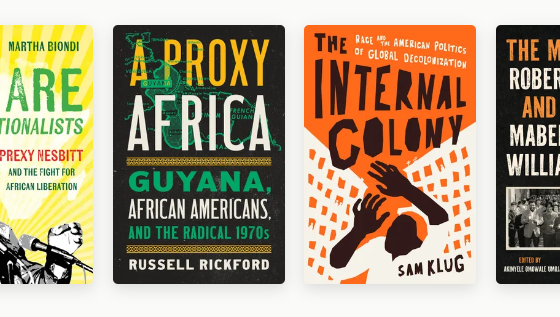
Conversations in Black Freedom Studies (CBFS) is a free public education series hosted by the Schomburg Center for Research in Black Culture. In connection with the online event on Black Power Internationalism on Thursday, October 1st, CBFS media fellow Lucien Baskin interviewed three of the guest speakers: Martha Biondi, author of We Are Internationalists: Prexy Nesbitt and the Fight for African Liberation, Sam Klug, author of The Internal Colony: Race and the American Politics of Global Decolonization, and Russell Rickford, author of A Proxy Africa: Guyana, African Americans, and the Radical 1970s.
Conversations in Black Freedom Studies (CBFS): What led you to write your recently published books?
Martha Biondi (MB): During this period of “forever wars” by the United States, citizens seem comparatively disengaged from the warmaking done in our names than at earlier times in history. In contrast, masses of Americans protested the war in Vietnam, giving rise to continuing vigilance over US interventions or potential ones in the global south in the 1970s and 1980s. All of this culminated in the antiapartheid movement of the 1980s. My book tells the story of a remarkably effective grassroots, yet transnational social movement, based in Chicago that aimed to change US foreign policy and US corporate behavior overseas. Their story is creative and inspiring and showcases an internationalist sensibility that we can learn rich lessons from today.
Sam Klug (SK): My motivations for writing The Internal Colony were simultaneously intellectual and political. This book started as my dissertation, which I started working on in 2015. The political context of that moment—especially the early phase of the Black Lives Matter movement during and after the Ferguson uprising—had a profound influence on the questions I was asking in my research. The policy platform released by the Movement for Black Lives (M4BL) in August 2016 had a deeply internationalist bent, and I think that had an impact on me as I was figuring out a dissertation topic. Another important political context at the start of my research was the
conversation in the mid-2010s about the relatively low priority placed on internationalism and
anti-imperialism in the early post-Occupy renaissance of the U.S. left—something that has
dramatically changed, for the better I think, in the intervening years.
The book also came out of a few distinct but overlapping frustrations I had about existing scholarship. I began working on this project during a boom time for African American intellectual history, and at a moment when the historiography on Black internationalism was reaching a new level of recognition decades after the pathbreaking work of Robin D. G. Kelley, Brenda Gayle Plummer, Penny Von Eschen, and others had stoked such interest in the field. Yet it seemed to me that scholars working in other sub-fields of U.S. history had not incorporated the insights of this work into their dominant narratives of postwar American history. Connected to that frustration was a sense that the relationship between the history of the United States and the history of global decolonization had not been adequately explored in the historiography on U.S. foreign relations. Examining the conceptual history of internal colonialism and its linkages to other ways that Americans thought about supposedly “domestic” issues of race and poverty in relation to colonialism and decolonization presented a way to address both these frustrations. In The Internal Colony, I argue that decolonization forced Americans to ask new questions about racial and economic inequality within their own country. Seen through that lens, Black internationalism appears at the very center of the story of midcentury American politics, providing the language in which fundamental conflicts over racial and class inequality were contested. Competing interpretations of colonialism and decolonization—and, in particular, its political economy—deepened the rift between postwar American liberalism and the Black freedom movement.
Russell Rickford (RR): I wanted to broaden understanding of African American constructions of diaspora and visions of transnational kinship and solidarity during the era of decolonization. By recovering 1970s Guyana as a site of African American radical hope, I also hoped to expand the social geography of Pan Africanism and reveal the full scope of contemporary black worldmaking practices.
CBFS: How does a focus on internationalism allow us to see the Black Power Movement differently?
MB: The Black Power movement has long been understood to have a transnational dimension. Whether in Canada, the Caribbean or in Africa, Black Power was a global phenomenon that shaped arts and culture and political organizing. Black Power encompassed the struggle against neocolonialism, and was also part of long standing Pan-African desires for global Black unity and political empowerment. The story I tell is part of this upsurge but also reflects a stream of organizing that had sharper anti-imperialist, labor and socialist identified orientation. It charts a multiracial cohort of activists that organized with church, labor and African solidarity groups, in solidarity with the left-leaning currents in southern Africa in particular. The group I chart in the book was deeply involved in organizing for the independence of Mozambique, Namibia, Angola, and South Africa.
SK: Most directly, a focus on internationalism allows us to see a wider array of influences upon the Black Power Movement, and a wider range of its effects. Thanks to incredible work by too many scholars to list—including the ones I’m privileged to be sharing this conversation with—we have a truly global understanding of the movement, which stretched from Guyana, to Mozambique, to India and New Zealand, to name just a few of its sites. These studies make it impossible to tell the story of Black Power without a sustained attention to anticolonial thought, Pan-African politics and aesthetics, and the shifting horizons of possibility created and foreclosed by changing developments in the international order in the era of the Cold War and decolonization.
To me, the greatest benefit from these interventions is perspectival. By interrogating how Black
Power activists understood their struggle within a global system of racial/colonial power, the
focus on internationalism undercuts a still-too-common popular understanding of Black Power as animated primarily by narrow, separatist agendas.
RR: Examining how Black Power and Black Arts Movement veterans pursued what I call “embodied solidarity” in Guyana reveals the salience of campaigns to “actualize” Pan African solidarity through diligent physical and technical service to postcolonial states that were deemed “progressive” and “black.”
CBFS: What is one lesson from the lives and work of the organizers you write about that resonates with you today in this political moment?
MB: A lesson from Prexy Nesbitt’s lifetime of organizing is that effective campaigns require honest and open relationships and dialogue. The international flow of information was crucial to challenging apartheid propaganda or the lies and omissions of our own mainstream media. Today we face complicated disinformation campaigns. Activists in the 1970s and 1980s used international travel, witness and media-making to educate Americans about their government’s deeds and misdeeds.
SK: At this moment, I’m particularly taken by the vision of the thinkers and activists of the twentieth-century Black freedom movement, and by their ability to maintain and reimagine their visions of a just society while fighting daily, immediate, arduous battles. One of the main characters in The Internal Colony, especially its last few chapters, is James Boggs, who exemplified this trait. Throughout his long life, Boggs survived racial terror in the Jim Crow South, endured exhausting labor in the auto plants of Detroit, fought against racism in the labor movement, faced FBI surveillance, and experienced wrenching losses of opportunity and community wrought by deindustrialization. As he and his partner in thought, life, and organizing Grace Lee Boggs put it in 1974, though, their commitment to revolution “is not just for the purpose of correcting past injustices.” Instead, “a revolution involves a projection of man/woman into the future. It begins with projecting the notion of a more human human being, i.e., a human being who is more advanced in the specific qualities which only human beings have—creativity, consciousness and self-consciousness, a sense of political and social responsibility.”
Today, the array of institutional, intellectual, and violent attacks against antiracist and progressive priorities is dizzying. From the panic over DEI and assaults on Black leadership in
universities, the military, and other institutions, to the unaccountable violence of ICE agents on
American streets, to the ongoing genocides in Gaza and Sudan, to the technofascist projects of
some in Silicon Valley, the sheer number of fronts on which struggle must take place can seem
paralyzing. James and Grace Lee Boggs always held fast to the belief that quotidian struggles
against injustice—however acute—must be invigorated and nurtured by a positive vision of the
better selves and the better world we hope to create.
RR: African American encounters with both statist and grassroots Pan Africanisms in Guyana underscore the need for self-reflexiveness, deep democracy, and popular liberation as guiding principles for leftists and internationalists.
Author Biographies
Martha Biondi is Lorraine H. Morton Professor of African American Studies and Professor of History as well as the Director of the Center for African American History at Northwestern University. She teaches classes in 20th Century African American History with a focus on social movements, politics, labor, gender, cities, and international affairs. In addition to We Are Internationalists, Biondi is the author of To Stand and Fight: The Struggle for Civil Rights in Postwar New York City and The Black Revolution on Campus.
Sam Klug is an Assistant Teaching Professor in U.S. History at Loyola University Maryland. He received his Ph.D. from Harvard University in 2020. His first book, The Internal Colony: Race and the American Politics of Global Decolonization, was published by the University of Chicago Press in 2025. His work has been supported by the American Council of Learned Societies, the LBJ Presidential Library, the Rockefeller Archive Center, and the Radcliffe Institute for Advanced Study. His writing has appeared in Diplomatic History, the Journal of the History of International Law, Politico Magazine, the Boston Review, Dissent, and other venues.
An associate professor of history at Cornell University, Russell Rickford specializes in African American political culture after World War II, the Black Radical Tradition, and transnational social movements. His latest book, A Proxy Africa: Guyana, African Americans, and the Radical 1970s, was released by the University of North Carolina Press in 2026. His previous monograph, We Are an African People: Independent Education, Black Power, and the Radical Imagination, received the 2016 Hooks Institute National Book Award and the 2017 OAH Liberty Legacy Foundation Award.