By A. Naomi Paik
Golnar Nikpour’s striking new book, The Incarcerated Modern: Prisons and Public Life in Iran (Stanford University Press, 2024), traces the emergence, expansion, and revisions to carceral systems in Iran from the early 20th century to the present – across periods of tumultuous, revolutionary change and opposing political regimes. This period marks a remarkable transformation – from Iran’s virtual absence of prisons to its becoming one of the most carceral nations on earth.
Nikpour interprets the prison not just as a site of suffering and torture within its walls, but as “a generative public locus for questions of citizenship, rights, and political belonging and unbelonging.” She traces how, under different regimes, people within and beyond Iran –ranging from historic figures like the shah to dissident organizations to ordinary people—came to understand the shifting, yet continuous contours of Iranian statecraft and their relations to it. The modern prison in Iran also circulated knowledge. It became a laboratory for the state and for revolutionary and oppositional politics. It was a tool the state used to instruct ordinary people how to behave under shifting regimes of social control.
The Incarcerated Modern is timely and historical. It is deeply rooted in a specific time and place yet expansive in its connections to other sites globally. Nikpour’s work contributes to conversations about prison regimes and carceral forms of social control in a global framework shaped by imperialism.
In what follows, Nikpour fleshes out how she first came to this topic, the innovative methods she used to pull the story and argument together, and the stakes of this knowledge, particularly in conversation with scholars studying carceral regimes elsewhere.

Tell us about yourself and how you came to focus your research on incarceration in Iran. Why is it crucial to understand the carceral state to understand modern Iran? Why is Iran important to understand prison regimes in the 20th and 21st centuries?
I’m a scholar of modern Iran. My interest in Iranian prisons stems directly from my investment in Iranian political and intellectual history. Prisons have been extraordinarily important to modern Iranian political movements since the late 19th century – innumerable political organizations and parties and individual political efforts have been born from carceral contexts. Awareness of political incarceration is so widespread in contemporary Iranian popular culture that most Iranians across the political spectrum grow up routinely reading and hearing stories about surveillance, policing, and incarceration. Certain incarcerated dissidents are household names in Iran, both before and after Iran’s Islamic Revolution of 1979. Prisons are so ubiquitous in the popular political culture of modern Iran that many take it as axiomatic that to lead a political life is to risk constant surveillance and policing and probable incarceration. My own upbringing is no different in this regard: I have been regaled with stories of political incarceration from my family and friends since I was a child. This led to my initial interest in Iranian carcerality. When I began this project years ago, I focused on tracking the political-intellectual history of the modern prison in Iran. Specifically, I was interested in what sorts of political movements and ideas were born from spaces of confinement and enclosure. I wondered, could we think of Iranian prison writing as a form of political theory?
As I began my research in earnest, however, I realized very quickly that to understand the history of modern carcerality in Iran, I would need to go much further than reading the work of incarcerated dissidents. My research led me to understand that the adoption of modern carceral methods – that is, mass surveillance, policing, punishment, and incarceration – has changed the lives of all Iranians, not just those of the most politically active. After all, the overwhelming majority of those caught up in Iran’s new modern prisons were and remain overwhelmingly common law prisoners, particularly those on low-level drug offenses. Legal centralization and institutionalization, which happened in earnest in Iran in the 1920s and 1930s after fitful earlier efforts, meant that everyone in Iran had to learn en masse how not to get arrested and what to do if they were. As such, my project became a history of the making, entrenchment, and expansion of the carceral state in Iran rather than a history of any political movements or discourses in particular – although I talk a lot about those things in the book too!
Can you outline for us the major pivot points you track in the rise and consolidation of the carceral state in Iran through this period of revolution and change?
The book charts Iran’s transformation from a decentralized empire with very few jailed persons even as late as the 1920s into one of the most heavily carceral modern nation states per capita in the world today. (Of course, the most heavily carceral state in the world, by many orders of magnitude, is the United States.) How is it that this transformative institution got entrenched and normalized in Iran? What did it have to do with the making of the centralized modern state and nationalism more broadly? How did people experience their increasingly surveilled and punished lives in the context of expanding legal and penal institutions? And what relationship did these processes have to global transformations elicited by globalizing capital and European and then American imperialisms?The book traces these changes over three distinct periods: the late Qajar period (1848-1925), the Pahlavi period (1925-1979), and the Islamic Republic period (1979-present). Before the 20th century, imprisonment in Iran for any reason was quite rare, although some small jailing facilities did exist. Long prison terms were essentially nonexistent. The impulse to build modern prisons in Iran came in large part from modernizing reformers in the Qajar era, who were moved by civilizational anxieties born of the exploitative and hierarchical nature of Iran’s encounter with European colonial powers. These reformers were concerned that Iran had fallen behind the “civilized” European states and viewed the rule of law – and with law, prisons – as a way to restore Iran’s global standing. It was during the subsequent Pahlavi era that Iranian law was fully codified and centralized, with tens of new prisons being planned and built. The use of prisons would only expand thereafter, particularly in the aftermath of the 1953 CIA-led coup that ousted a popular nationalist prime minister and restored the autocratic shah to the throne, and again after the 1979 revolution. I address all of these eras and argue that – even across major coups and world-historical revolutions – the carceral system first built in Iran the early part of the 20th century has only expanded its reach.
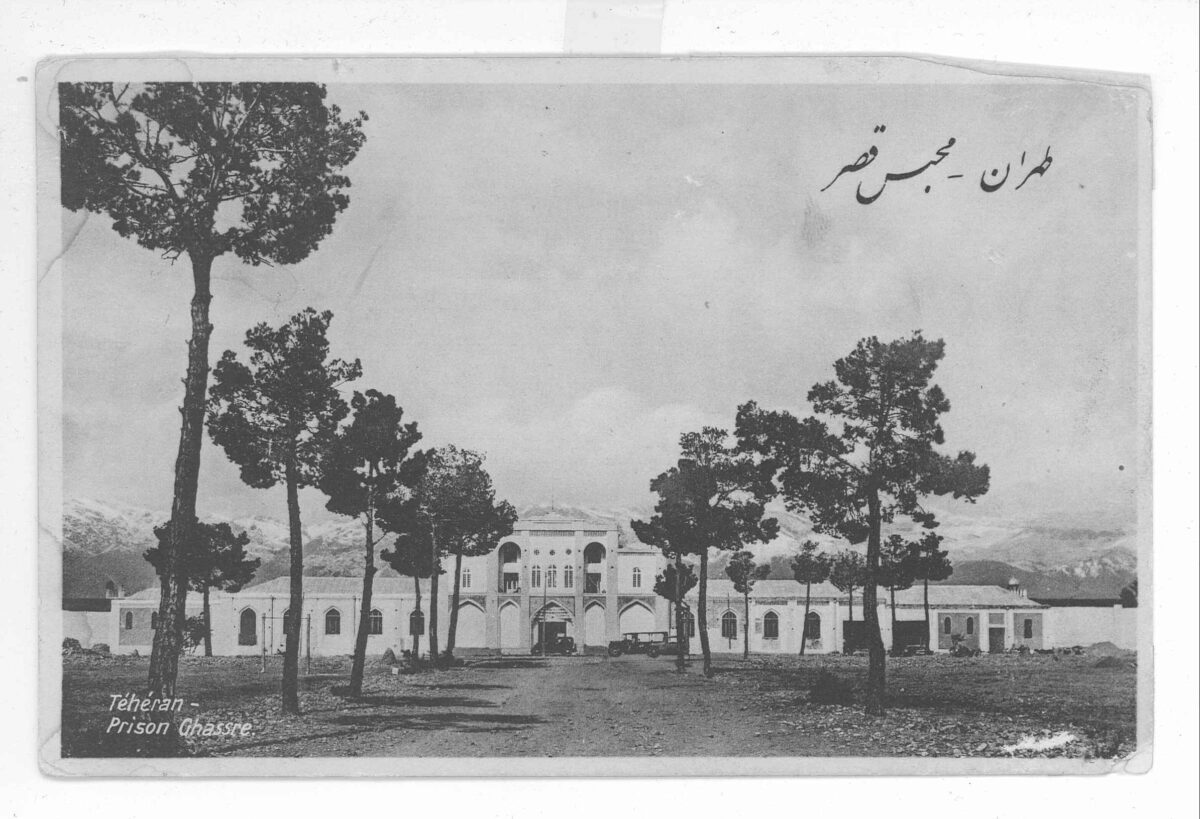
Qasr Prison, 1930s. Source: The Institute for the Study of Contemporary Iranian History Archives, Tehran.
You draw on a rich archive of state-based sources that you read against their intended purposes, as well as from sources that Kelly Lytle Hernández might describe as a “rebel archive,” found in literature and in revolutionary ephemera and papers of guerilla resisters to the Iranian state. Can you tell us more about your research process and the different approaches to reading and interpreting these diverse/divergent archives you had to mobilize?
I spent a decade conducting research for this book in private and public archives across several countries in Europe, all over the United States, and the Islamic Republic of Iran. In some ways, it was a difficult process in which many doors and avenues of research were closed due to the sensitivity of my research topic. The resulting book is a direct outgrowth of these closed doors insofar as limitations forced me to think capaciously about the archive of modern carcerality. I looked at everything from official state archives, to newspapers and magazines, to memoirs and prison writings, to political and revolutionary ephemera, to published and unpublished texts by criminologists, sociologists, and public health experts in Iran, to crime fiction and film. I also spoke to numerous former prisoners, who were generous enough to open their homes, memories, and personal archives to me – something I consider an honor and for which I will always be extraordinarily grateful.
Opposition and dissident materials from both before and after the 1979 revolution are central to the archive of the book. Social movements have long worked to render visible the violent inner workings of carceral institutions in Iran (and indeed around the world). From as early as the late 19th century, political dissidents in Iran have been writing about new institutions and techniques of modern carcerality, publishing maps and other crucial information about prisons, writing about their experiences, and producing work theorizing the emergence and entrenchment of these institutions and techniques of control. I argue that these opposition discourses have produced an active archive-in-opposition that has directly challenged both the historical and ethical narratives of subsequent Iranian governments to their core.
What, exactly, do you mean by “the public life of the prison”? How does the circulation of “the prison” function in public discourse for the state, for opposition to the state, and other actors?
I use the phrase “the public life of the prison” in two linked senses. The first refers to new public conversations about modern prisons elicited by the centralization of law and the building of new penal sites. From the moment these massive reforms began in the 1910s and 1920s, Iranians of all stripes began talking about, writing about, and thinking about what they meant for everyday life. As I note in the book, Iranians had to learn en masse how not to get arrested and incarcerated and what to do if they were. As was the case for people everywhere, Iranians learned through new forms of public culture that emerged from this encounter: prison memoirs, academic criminology, newspaper accounts of crime and punishment, crime fiction and film, and of course face-to-face encounters with the carceral institutions of the modern nation state. As I noted above, Iranian dissidents have played a big part in this process, publicizing the inner workings of modern prisons while also engaging in crucial political organizing from behind prison walls.
Yet, as I argue in the book, the public life of the prison does not only encompass that which dissidents have said or written in response to modern incarceration. Modern carcerality has transformed all Iranian social and public worlds, not just those of the most politically engaged. My argument is not simply that modern carcerality has produced new public cultures in Iran – though of course it has – but rather that carceral practices have shaped the very notion of the public. This is the second sense in which I theorize the public life of the modern prison. Throughout the book, I show that in assiduously policing the line between “good citizen” and “bad criminal,” carceral techniques of the centralized modern state have shaped Iranian notions of citizenship, freedom, and nationalized inclusion.
How do you see your analysis of the modern prison regime in Iran in relation to the “prison industrial complex” or prison regimes in other locales, including ostensible liberal democratic states, and globally? What does looking closely at Iran elucidate about the function of the prison to the state?
I have come away from this work believing to my core that we cannot readily divide carceral states into good / liberal on the one hand and bad / illiberal on the other. This is often the unstated (or sometimes stated!) undercurrent of mainstream discourses on Iranian prisons, which are presented as pathologically violent as a result of some seeming defect in Iranian or Islamic culture.
I argue in the book that modern carceral techniques are not natural, stable outgrowths of forms of governance or static essential cultures or religions — that is to say, we cannot
speak coherently of essential forms of “fascist punishment,” “liberal punishment,”
“Islamic punishment.” There are, of course, historical distinctions between carceral states and regimes, but it is clear that carceral practices are shared across borders and governments. In the 1920s and 1930s, Iranian statesmen and law enforcement officials undertook prison reform after direct engagement with European conferences on prisons and policing. In the 1960s, Iranian prisons were built directly from blueprints taken from their U.S. counterparts. (In fact, the blueprints for USP Marion in Marion, Illinois were used in Iran, Israel, New Zealand, and elsewhere.) Today, the Islamic Republic uses globally popular prison, policing, and surveillance tech such as facial recognition cameras, ankle monitors, and various other forms of biotech. All but the most ideologically deluded would have to admit liberal states also torture.
Where has the journey of this book taken you? What are you working on next?
I’ve been incredibly lucky. This book has taken me all over the world. What I sincerely cherish most about this journey is the number of people who opened their doors and lives to me to share with me their personal experiences – sometimes extraordinarily brutal, yet many often genuinely hopeful – of incarceration in Iran. Everywhere I have gone, I have met people who share my conviction about the fundamental failures of the project of the modern prison, and the need to move away from this institution altogether in search of a more just world.
I am now working on two projects: one, a new research project on the ephemeral archive of the 1979 revolution in Iran. I am interested in what was transient about that transformative moment – including the feeling of freedom – and in questions of how we engage with an archive that is by definition always incomplete. The second is an introductory text to modern Iranian history I am tentatively calling A People’s History of Iran, meant to serve as an antidote to the typical story about Iran that we hear in the United States.
AUTHOR BIOS
Golnar Nikpour is an Assistant Professor of History at Dartmouth College and a scholar of modern Iran with a particular interest in histories of law, revolution, and rights. Her research has been supported by the Social Science Research Council, the A.W. Mellon Foundation, and the Whiting Foundation, and her writing has appeared in Comparative Studies of South Asia, Africa and the Middle East; Humanity: An International Journal of Human Rights, Humanitarianism, and Development; The International Journal of Middle East Studies; Iranian Studies; The New York Times, Tehran Bureau, and Jadaliyya. Since 2019, Nikpour has served on the editorial collective of the journal Radical History Review, and she also serves the editorial board of the Radical Histories of the Middle East book series on Oneworld Press. Her first book, entitled The Incarcerated Modern: Prisons and Public Life in Iran is out now on Stanford University Press.
A. Naomi Paik is the author of Bans, Walls, Raids, Sanctuary: Understanding U.S. Immigration for the 21st Century (2020, University of California Press) and Rightlessness: Testimony and Redress in U.S. Prison Camps since World War II (2016, UNC Press; winner, Best Book in History, AAAS 2018; runner-up, John Hope Franklin prize for best book in American Studies, ASA, 2017), as well as articles, opinion pieces, and interviews in a range of academic and public-facing venues. Her next book-length project, “Sanctuary for All,” calls for the most capacious conception of sanctuary that brings together migrant and environmental justice. She has coedited four special issues of the Radical History Review—“Militarism and Capitalism (Winter 2019), “Radical Histories of Sanctuary” (Fall 2019), “Policing, Justice, and the Radical Imagination” (Spring 2020), and “Alternatives to the Anthropocene” (Winter 2023). She coedits the “Borderlands” section of Public Books alongside Cat Ramirez, as well as “The Politics of Sanctuary” blog of the Smithsonian Institution with Sam Vong. She is an associate professor of Criminology, Law, and Justice and Global Asian Studies at the University of Illinois Chicago.