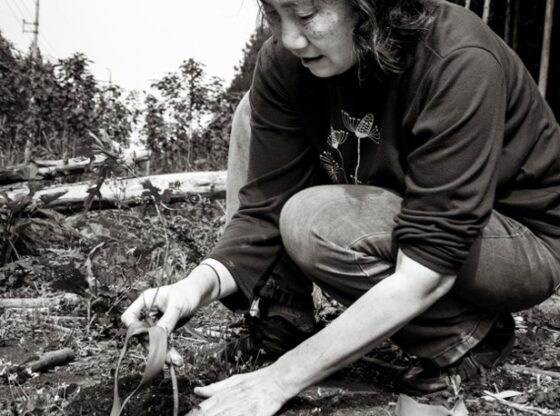
 Choi Sung-hee in the Bijarim-ro forest, 2020. If the second airport, which people suspect to be an air force base, is built in eastern Jeju, this forest will be greatly destroyed as the adjacent road, which would lead to the airport, will be expanded. Photo by Oh Young-chul.
 Interview by Christine Hong Christine Hong: Sung-hee, you were at the heart of the International Solidarity Committee, tirelessly calling attention to the plight of the…
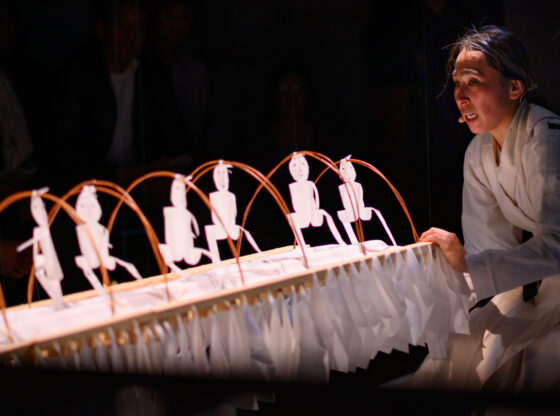 Dangkuel. Photo provided by Dohee Lee.
 Forum 5.6 // “So Many Stories You Never Heard”: An Inheritance of Loss (an interview with Dohee Lee)
In this 2015 interview for the Legacies of the Korean War oral history project, Dohee Lee, a Bay area-based, Jeju-born artist whose music and dance…
 "Unnamed Monument” at Jeju 4.3 Memorial Park,
(by Lee Dong Hyun, the Jeju 4.3 Research Institute)
"Unnamed Monument” at Jeju 4.3 Memorial Park,
(by Lee Dong Hyun, the Jeju 4.3 Research Institute)
By Youjoung (Yuna) Kim The first object that visitors see when they enter the Jeju 4.3 (Sasam)[i] Memorial Park is a white memorial stone lying…
 U.S. military operational map of Jeju circa the 4.3 uprising and genocide
 By Kim Jongmin The “Jeju 4.3 Incident” occurred during the administration of the United States Army Military Government in Korea (USAMGIK) when the United States…

By Jane Jin Kaisen The excerpt from “Ghosts,” the first video in Jane Jin Kaisen’s 8-channel video installation Reiterations of Dissent (2011/16), begins with the…
 Evacuation on May 10, 1948, the day of the national election.
 By Hyun Ki-young Many writers have unbearably painful or tragic memories of their youth and choose to become writers as if ordained by fate. Such…
 Entitled “Released after 60 years,” this work by Jeju artist Koh Gil-chun is a charcoal rubbing of clothes excavated from a mass grave of islanders killed during Sasam. Source: the Jeju 4.3 Peace Foundation
 By Christine Hong Introduction: Jeju Sasam as Deimperializing Korean War History The anticolonial Swedish writer, Sven Lindqvist, once remarked that to Americans, the Korean War…
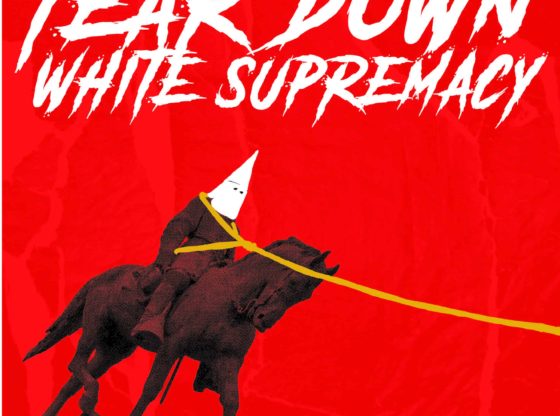 Art by Jesus Barraza and Melanie Cervantes via JustSeeds.
 In September 2018, students, faculty, and staff at Duke University rallied alongside local residents to advocate the renaming of Carr Building due to the legacy…
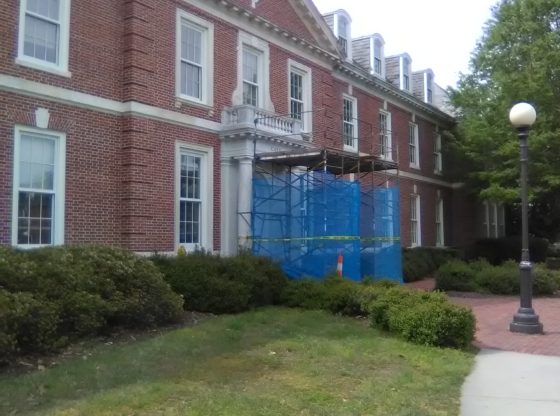 Removing Carr from the building. Photo by Anderson Hagler.
 By Anderson Hagler In 2017, the Los Angeles County Board of Supervisors passed a motion to officially changed the name of Columbus Day to Indigenous…
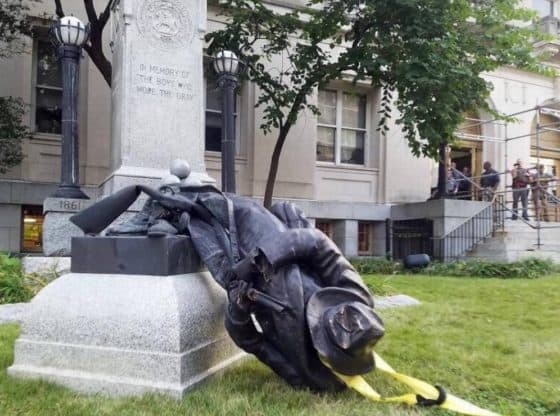 The "Confederate Soldiers Monument" after protestors brought it to the ground in Durham, NC, 2017. Photo via the News & Observer.
 By James Chappel In his 1963 “Letter from a Birmingham Jail,” Martin Luther King, Jr., explains the greatest impediment to progress. It is not, in…